The pattern
The equal concept
The question tells you a part of one pile equals a part of another.
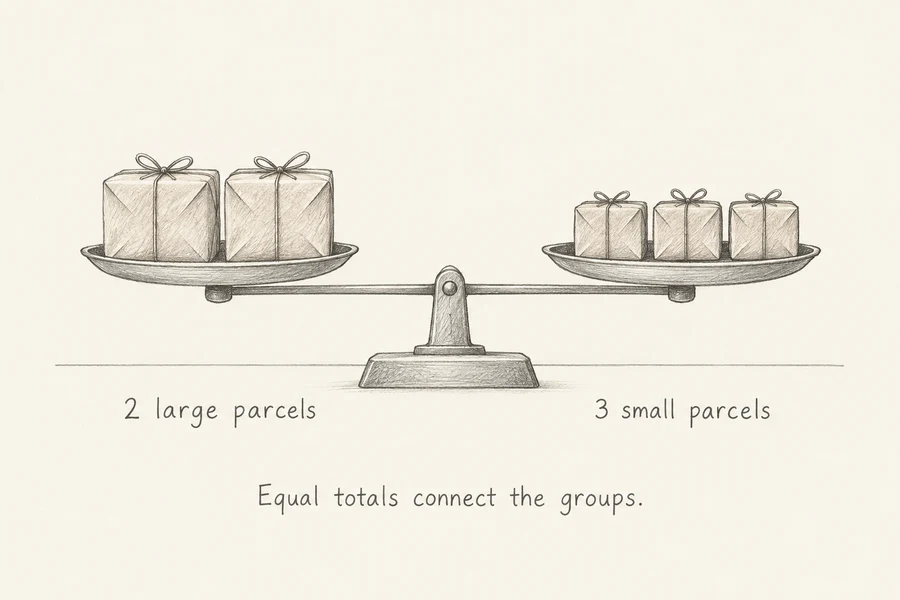
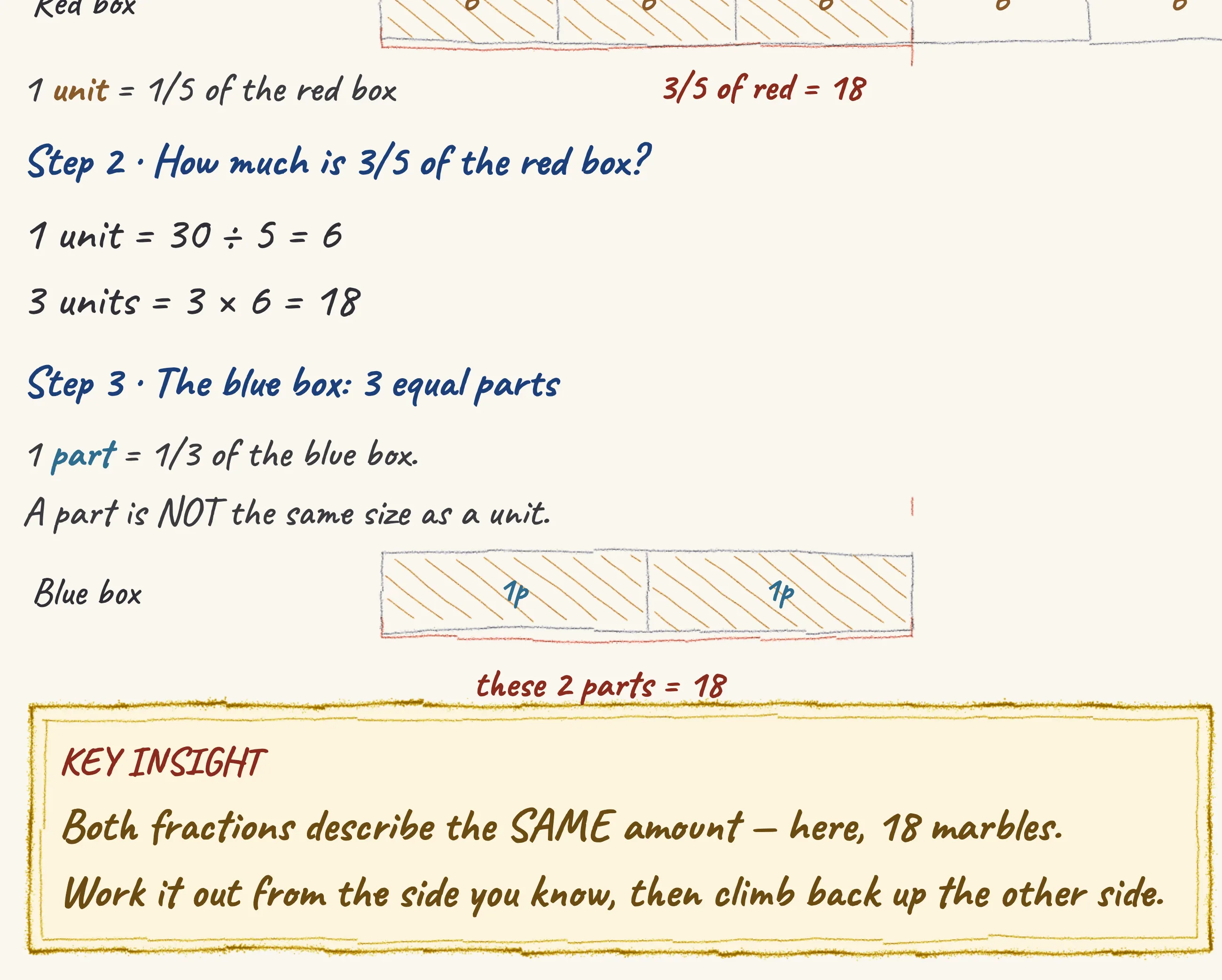
Two piles get measured with two different fractions, and the question tells you those fractions describe the same amount. Rewrite both so they share the same top number, and the sizes of the two piles fall out as a ratio. That stated equality is what lets two separate wholes be compared at all.
How to spot it
Two different groups each get their own fraction or percentage, and the question links them with 'the same as', 'twice as many as', or a shared cost across different units.
Common mistake
Children compare the two fractions without first relating them to a common whole. A smaller fraction of a larger group can be bigger than a larger fraction of a smaller group.
7 worked solutions
Standard
- Files and pens — the cost of 1 pen The total cost of 2 identical files and 1 pen is $19.05. The total cost of 3 such files and 5 such pens is $44.50. Find the cost o…
- Marbles — red and blue boxes, matching fractions 3/5 of a box of red marbles equals 2/3 of a box of blue marbles. The box of red marbles contains 30 marbles. How many blue marbles…
Challenging
- 370 visitors — who bought a raffle ticket A charity fun fair had 370 visitors, made up of children and adults. 7/9 of the children and 7/10 of the adults bought a raffle ti…
- 810 workers — who finished on time A factory has 810 workers, made up of assembly-line workers and packing workers. 7/12 of the assembly-line workers and 8/9 of the …
- 836 students — who takes the bus There are 836 students in a school. 7/10 of the boys and 7/8 of the girls take bus to school. The number of boys who do not take b…
- Training workshop — men and women who didn't attend A company has 880 employees, made up of men and women. 5/6 of the men and 3/4 of the women attended a training workshop. The numbe…
Very challenging
The 33 problem patterns
All 33 patterns, one to a page — the 19 behind Primary 5 and 6 word problems, and the skills the younger years are built on. The bar model, how to spot it in the question, and the mistake children make. A booklet you can print. Free.