Patterns and skills
Explore 33 patterns and skills for Primary 1–6, from basic concepts to word problems. Each includes a diagram to help explain the method.
Find a pattern · 33 illustrated ideas
This page is also a booklet, one pattern to a page. Take a copy.
P1 · P2 · P3 · P4
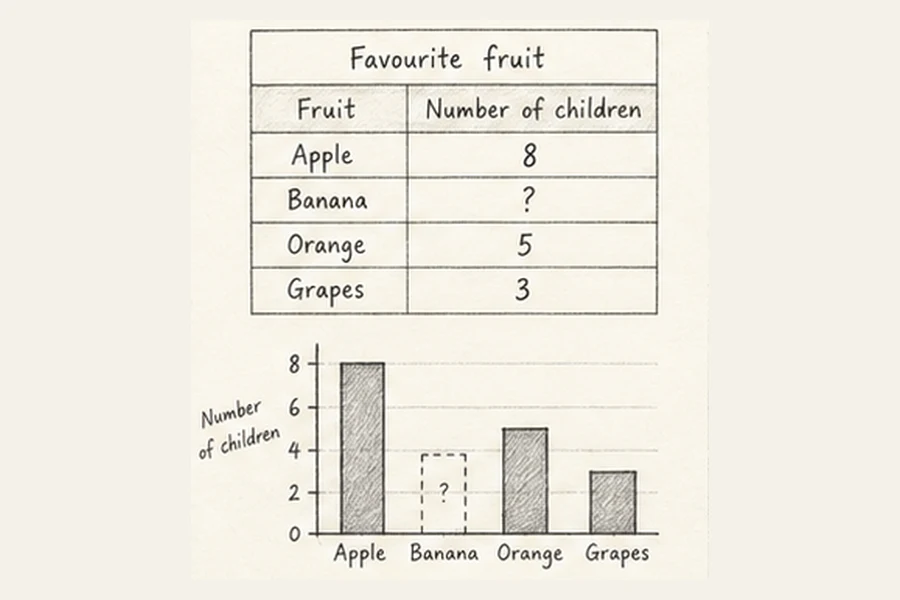
Read and complete data displays
Read the title and labels, locate the relevant values, then compare or complete only what the question asks.
How to spot it & common mistakes
How to spot it
The question shows a picture graph with rows of circles or icons. A key nearby says how many items one symbol stands for.
Common mistake
Children count the symbols correctly but forget to check the key, so they treat every symbol as one item even when it stands for two or more.
P3 · P4
Rectangle and square measurement
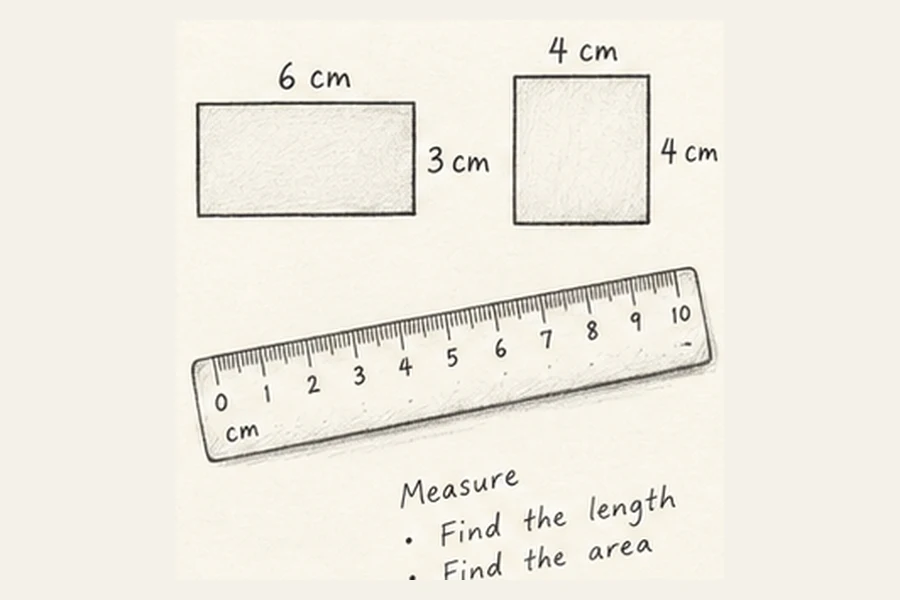
Use opposite equal sides, undo the area or perimeter formula, and count each outside edge once.
How to spot it & common mistakes
How to spot it
Squares tiling a rectangle, or a shape made of several rectangles joined together, point here. The question asks for area, perimeter, or the length of a missing side.
Common mistake
Children multiply length by width when the question actually asks for perimeter. On a composite shape, they add only the labelled sides and miss the ones they must work out themselves.
P2 · P3 · P4 · P5
Large numbers and operation order
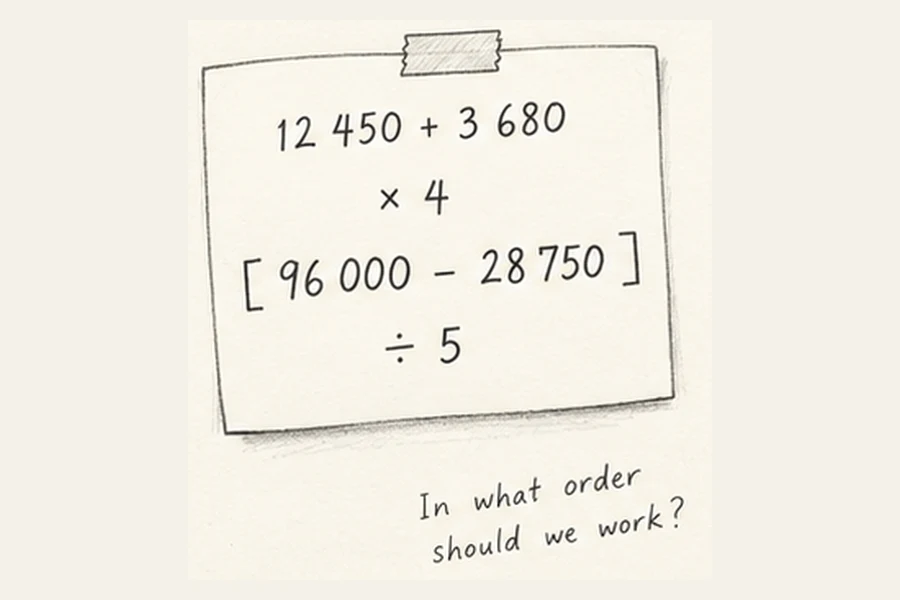
Group digits by place value, then do brackets and multiplication or division before addition or subtraction.
How to spot it & common mistakes
How to spot it
Two numbers to add with carrying, several numbers to put in order, or a sum mixing addition, multiplication and brackets, all point here.
Common mistake
Children forget to carry a ten into the next column, or compare digits from the left without first checking the numbers have the same number of digits.
P3 · P4 · P5
Angle and shape properties
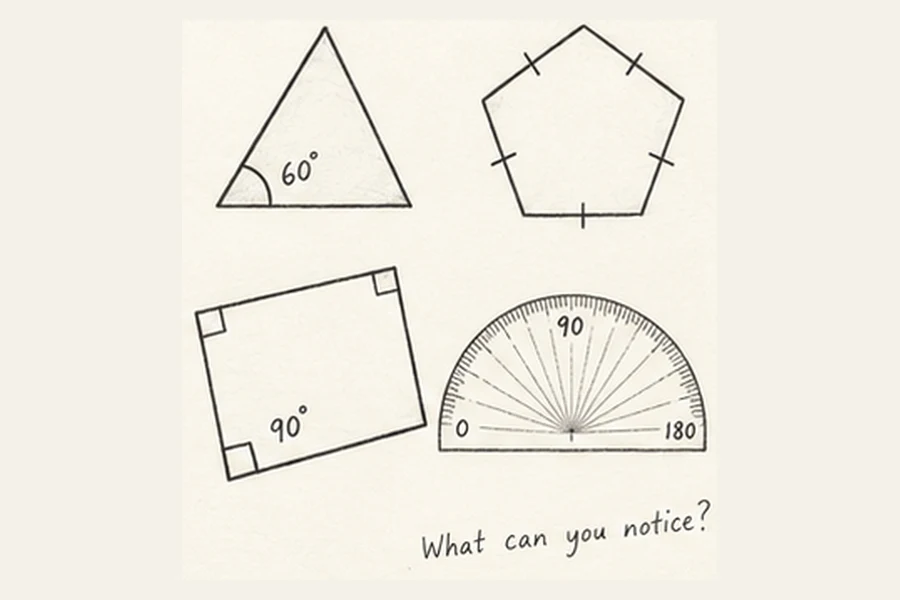
Mark the shape property first, then subtract known angles from the relevant total.
How to spot it & common mistakes
How to spot it
Look for a named quadrilateral like a rhombus or parallelogram, plus two straight lines crossing inside or through it. Words like "straight line" and "collinear" point to this move.
Common mistake
Children mix up which angle sits opposite which once lines cross at a point away from the main shape. Trace each ray back to its two labelled ends before deciding what faces what.
P5
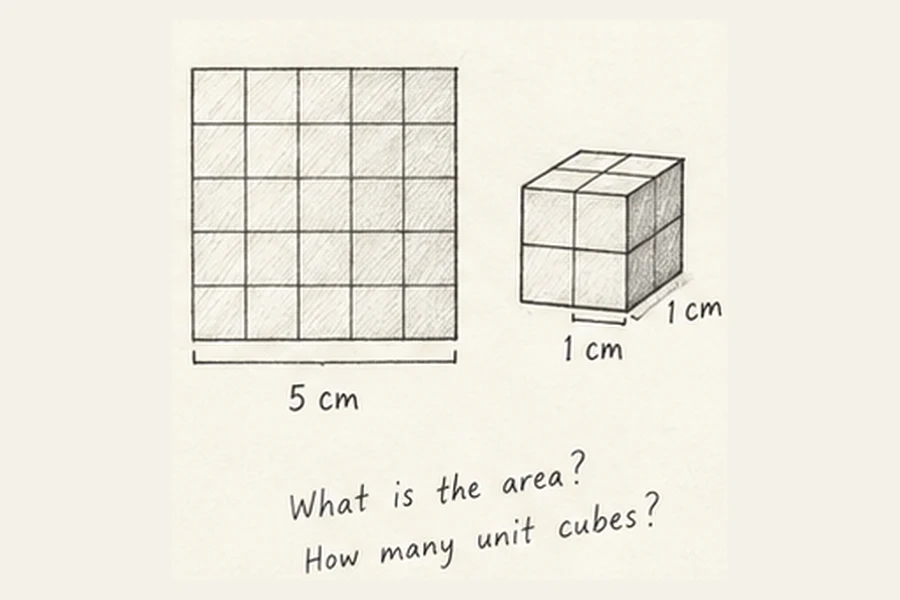
Area and volume foundations
Choose the matching base and perpendicular height, or count equal cube layers before multiplying dimensions.
How to spot it & common mistakes
How to spot it
Look for shapes drawn on a dotted or squared grid, sharing a side or a vertex, with names like ABCD and ABE. Words like "grid", "dots" or "squares" alongside a request to compare areas or heights are the giveaway.
Common mistake
Children measure height by eye along the slanted side of a shape instead of counting the straight up-down grid distance from the base to the opposite vertex, which gives the wrong height whenever a side leans.
P5
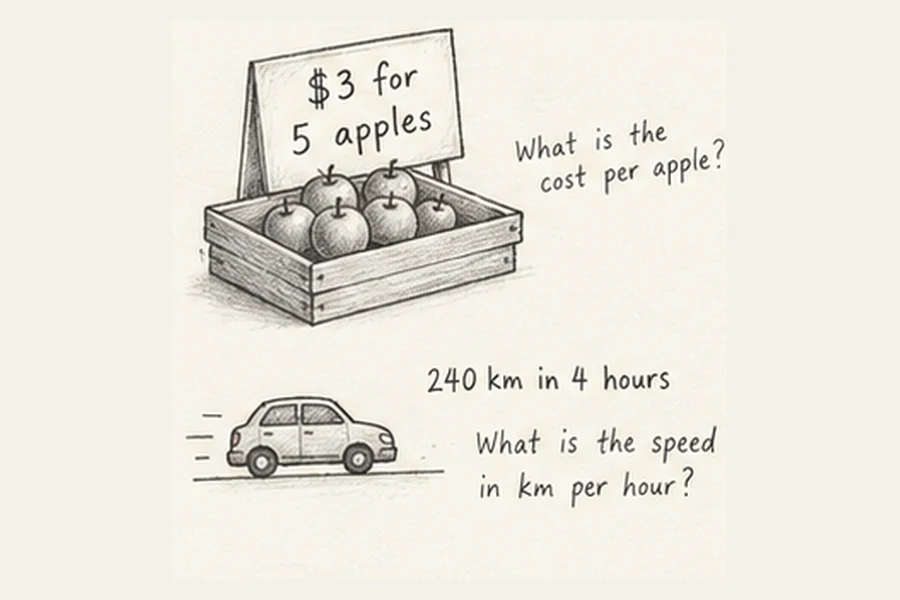
Rate as an amount per unit
Say both units aloud, then connect amount, rate and number of units.
How to spot it & common mistakes
How to spot it
The word 'each' or 'per' next to a ticket, item, or hour marks this. The question asks for a total, or asks for the rate itself.
Common mistake
Children multiply when they should divide, especially when the question gives the total and the number of hours and asks for the rate per hour rather than a bigger total.
P2 · P3 · P4 · P5
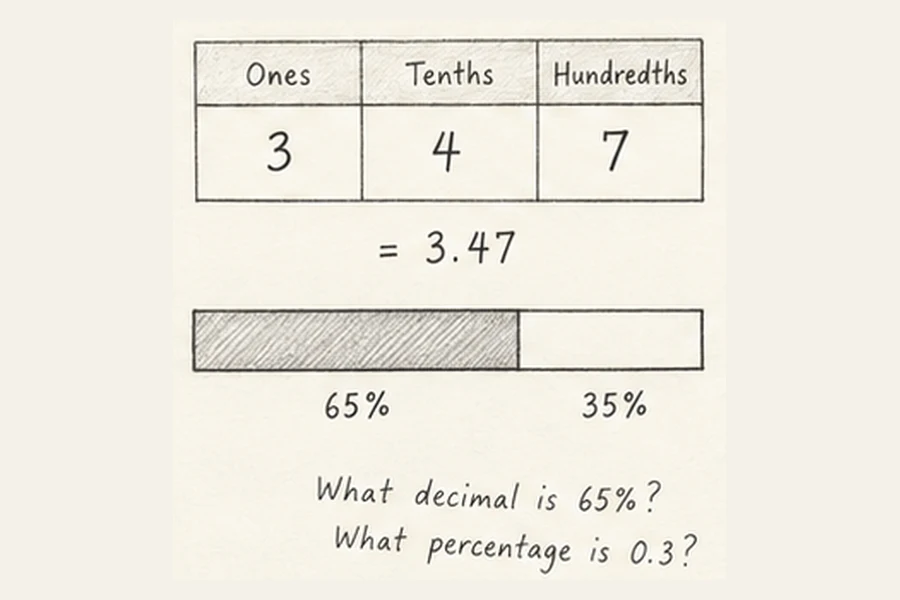
Decimals and percentages
Keep place values and the whole visible while scaling decimals or finding a percentage.
How to spot it & common mistakes
How to spot it
The question offers two possible units for the same kind of measurement, such as cm or km, or asks to read a time or a percentage from a picture.
Common mistake
Children pick the unit that sounds familiar rather than the one that fits the object's size, or read a clock's hour and minute hands the wrong way round.
P3 · P4 · P5
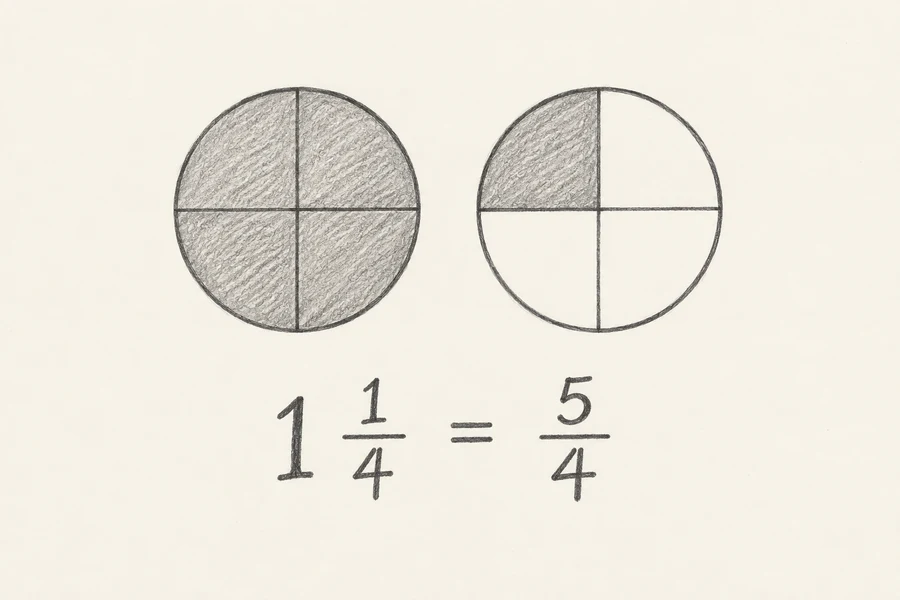
P5 fraction foundations
Translate division into a fraction, then calculate exactly with mixed and improper fractions.
How to spot it & common mistakes
How to spot it
Two fractions with different denominators to add or compare, or a mixed number to calculate with, point here.
Common mistake
Children add or compare the numerators straight away without rewriting the denominators to match first, treating a third plus a sixth as two sevenths.
P6
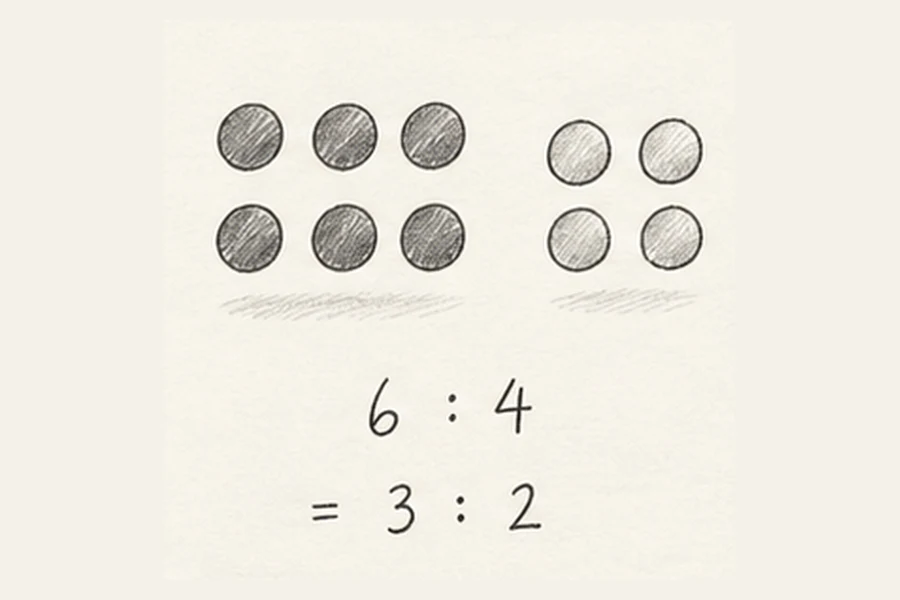
Forming and simplifying ratios
Keep the quantities in order and divide both by the same number.
How to spot it & common mistakes
How to spot it
The question names two quantities in a stated order, red to blue, or gives an existing ratio to reduce. Words like 'ratio' and 'simplest form' give it away.
Common mistake
Children write the numbers in the order they appear in the story rather than the order the question asks for. When simplifying, they divide only one of the two numbers instead of both.
P6
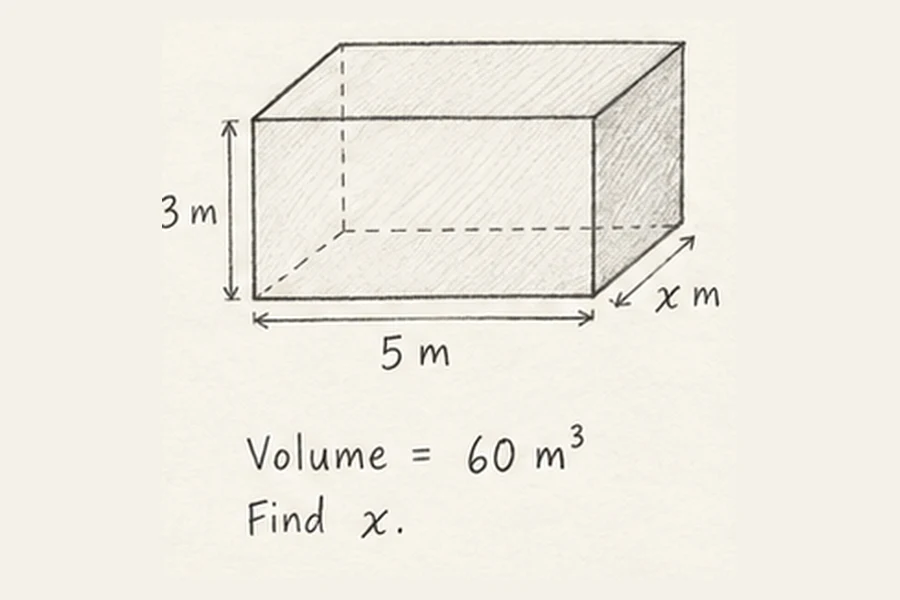
Work backwards from volume or area
Use the known area or volume to find the missing measurement.
How to spot it & common mistakes
How to spot it
The question gives a cuboid's volume with two dimensions and asks for the third, or gives the volume with one length and asks for a face area. A square's area given with its side asked for belongs here too.
Common mistake
Children divide the volume by a length lying inside the face they want, instead of the length that runs into it, and get the wrong kind of measurement.
P6
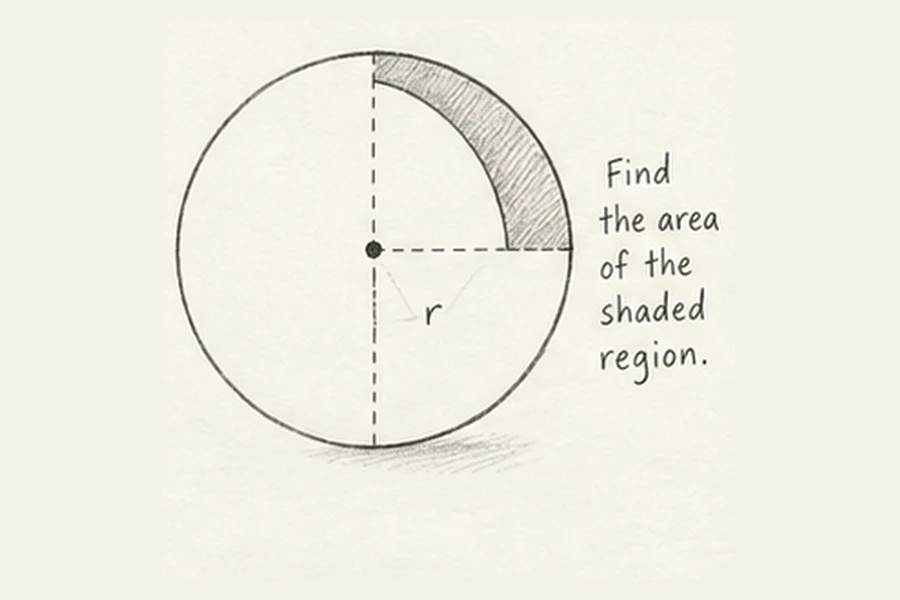
Circles and curved boundaries
Find the space inside a circle shape or the distance around its boundary.
How to spot it & common mistakes
How to spot it
'Area' asks for square centimetres from the radius. 'Circumference' or 'perimeter' on a curved edge asks for plain centimetres from the diameter instead.
Common mistake
Children give a circumference answer in square units, or find a circle's area without squaring the radius first, mixing up the two kinds of measurement.
P6
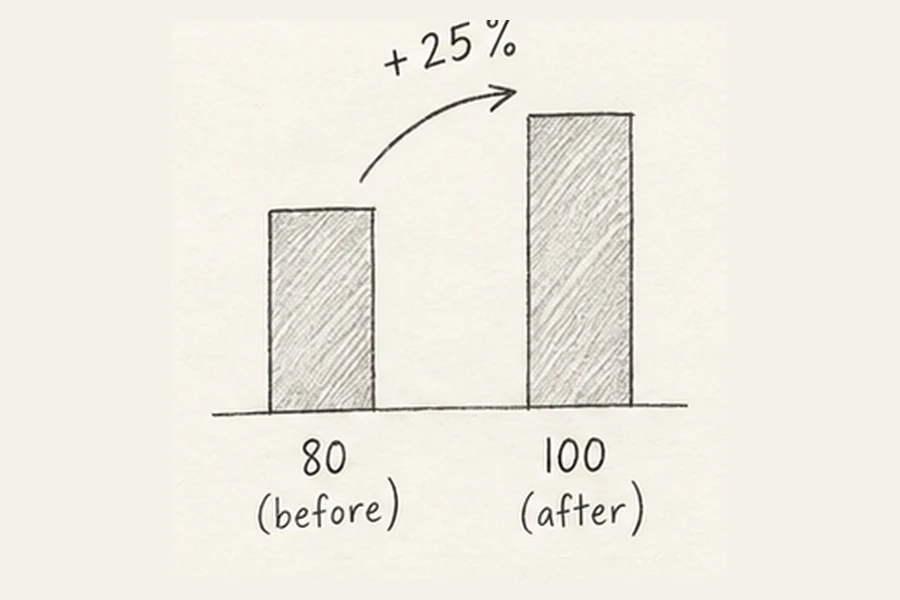
Percentage change
Compare how much an amount changed with its original value.
How to spot it & common mistakes
How to spot it
A quantity falls or rises from one stated figure to another, and the question asks for the percentage change. Words like 'decrease' and 'original price' give it away.
Common mistake
Children divide the drop by the new, lower price instead of the original price, which inflates the percentage they report.
P6
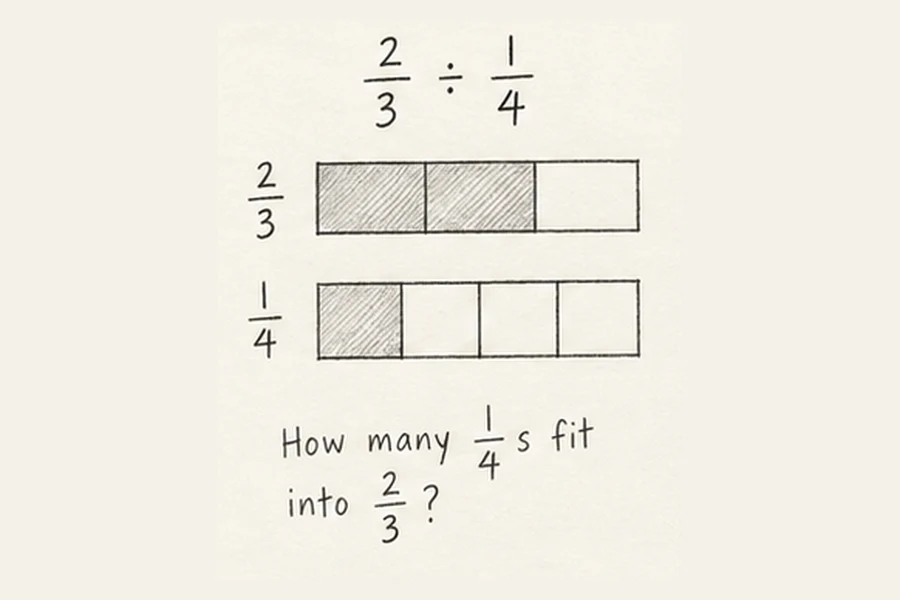
Dividing fractions
Share a fraction equally, or count how many small portions fit.
How to spot it & common mistakes
How to spot it
A total amount split into fraction-sized cups or pieces, asking how many fit, points here. A single fraction shared equally among several parts does too.
Common mistake
Children expect dividing to make the answer smaller, so a bigger result than the starting amount looks wrong to them and they flip the calculation.
P6
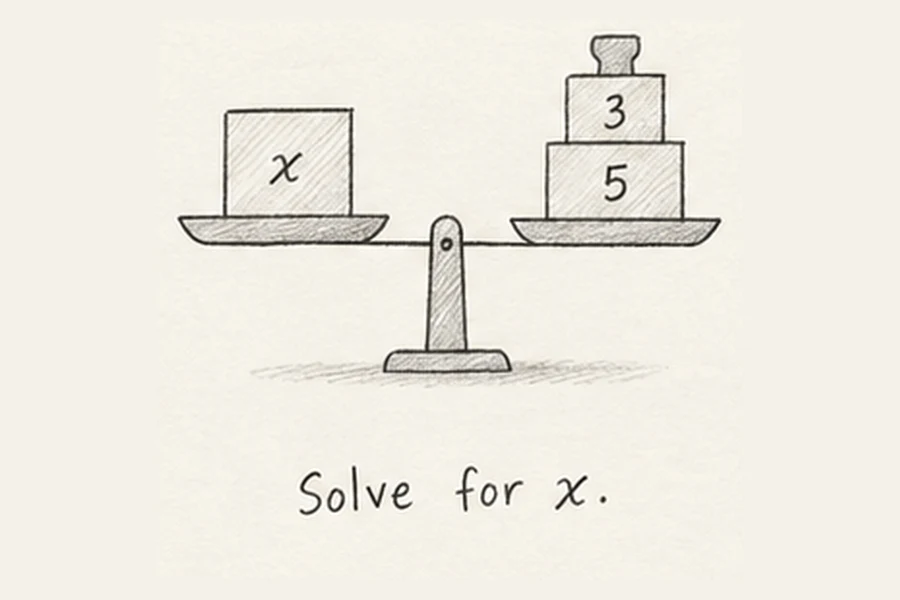
Algebra basics
Use a letter for an unknown number and work with what it means.
How to spot it & common mistakes
How to spot it
A story with a repeated cost and a fixed fee, written as an expression like 4x + 4, points here. So does a value for x to substitute in.
Common mistake
Children swap the two numbers round, using the fixed fee as the price per ticket and the price per ticket as the fixed fee.
P1 · P2 · P4 · P5 · P6
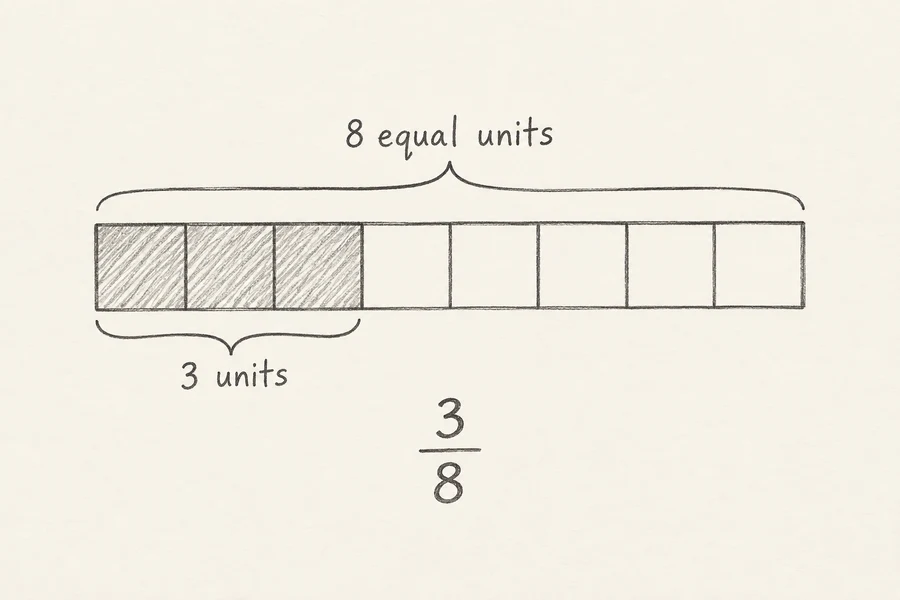
Units and parts
Cut one amount into equal shares. One number tells you what a share is worth.
How to spot it & common mistakes
How to spot it
A single amount is split by a ratio, a fraction or a percentage. One extra number gives you the leftover, the difference, or the value of one share.
Common mistake
Children match the given number to the wrong number of shares, using the whole bar when the number covers only the leftover or the difference between two people's shares.
P4 · P5 · P6
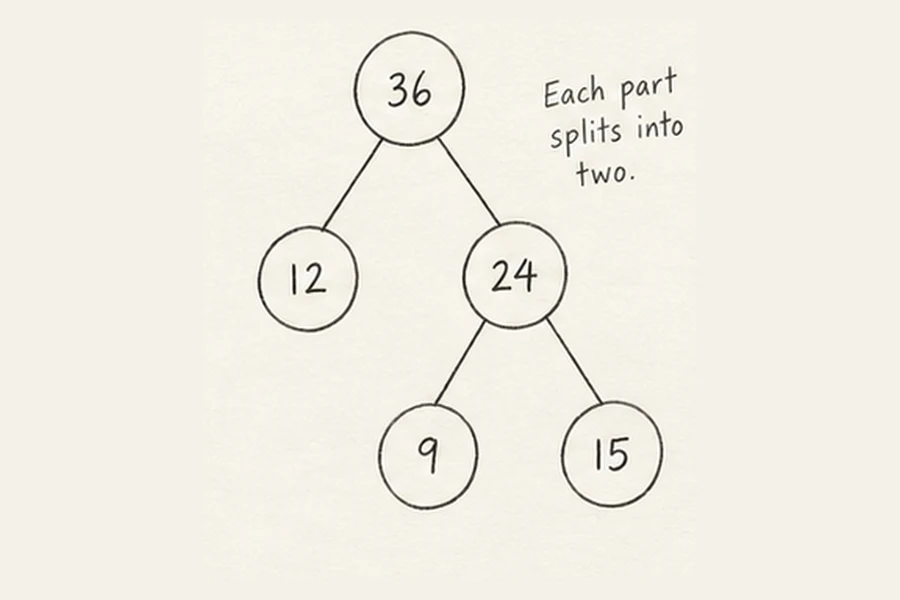
Branching
The second fraction is of one piece, not of the whole.
How to spot it & common mistakes
How to spot it
A second fraction arrives after the first and is attached to a piece rather than to the whole — 'of the remainder', 'of what was left', or 'of the ones that were red'.
Common mistake
Children take the second fraction of the original total instead of the piece it was named against, which makes the amount come out too big.
P5 · P6
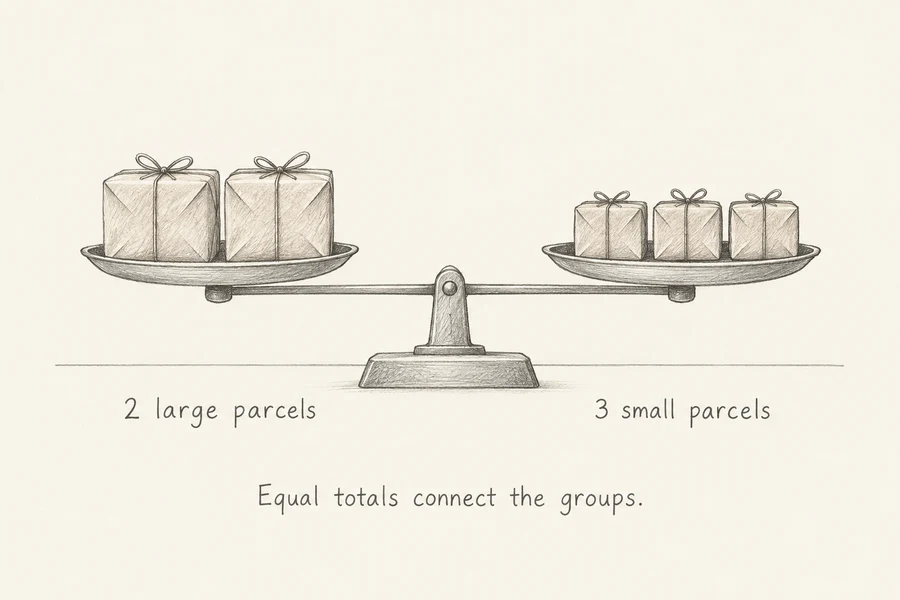
The equal concept
The question tells you a part of one pile equals a part of another.
How to spot it & common mistakes
How to spot it
Two different groups each get their own fraction or percentage, and the question links them with 'the same as', 'twice as many as', or a shared cost across different units.
Common mistake
Children compare the two fractions without first relating them to a common whole. A smaller fraction of a larger group can be bigger than a larger fraction of a smaller group.
P5 · P6
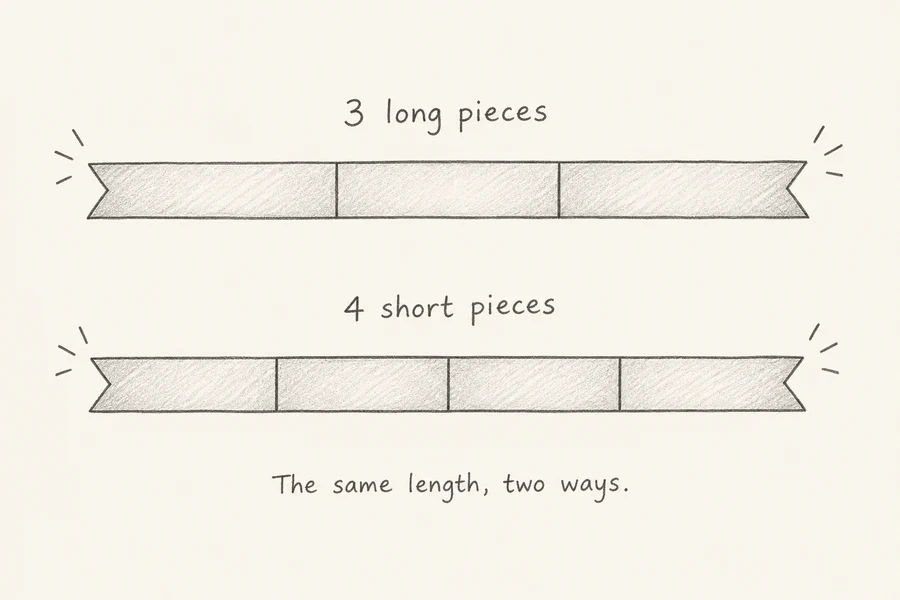
Repeated identity
One length or count, described two ways in the same question.
How to spot it & common mistakes
How to spot it
A shape or count is described from two viewpoints in the same question, such as one edge measured as a number of long pieces and again as a number of short pieces.
Common mistake
Children treat the two descriptions as separate quantities and add them. Both describe the same quantity, so the two must be equal.
P6
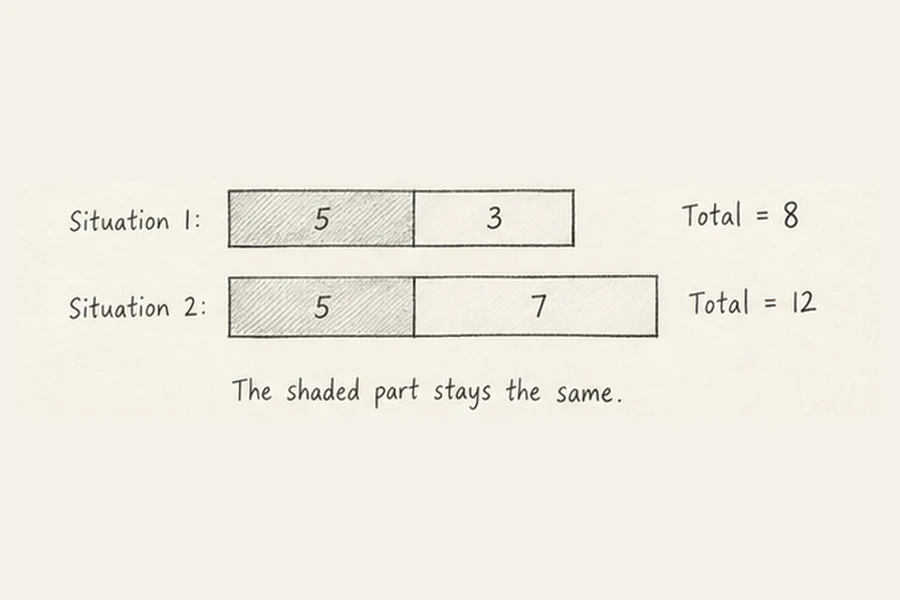
Constant part
The ratio changes, but one person's amount stays the same.
How to spot it & common mistakes
How to spot it
A ratio changes and the question tells you only one person gained or lost an amount, while the other kept what they had.
Common mistake
Children keep the same number of shares for the person whose amount did not change. The amount stays the same, but the size of a share can differ between the two ratios.
P4 · P5 · P6
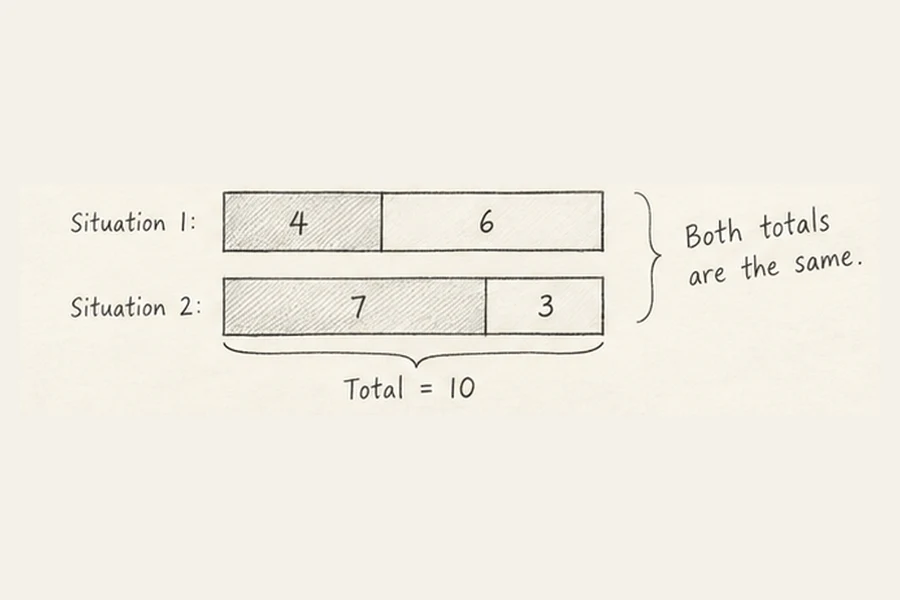
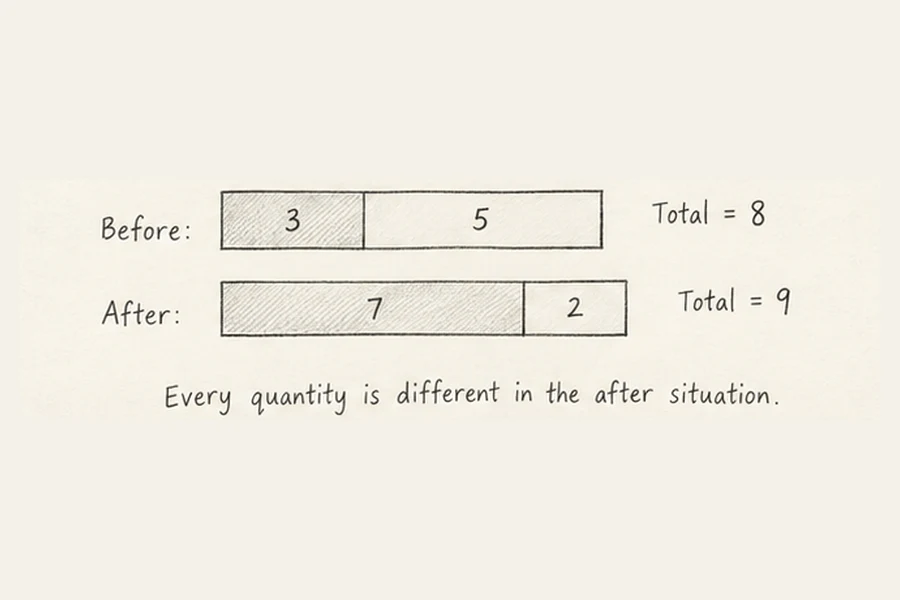
Constant total
Money moves between two people, so their total never changes.
How to spot it & common mistakes
How to spot it
One person gives, sells or loses an amount to the other, and nobody outside the two people gains or loses anything.
Common mistake
Children draw different totals before and after, or forget that moving an amount from one person to the other changes the gap between them by twice that amount.
P6
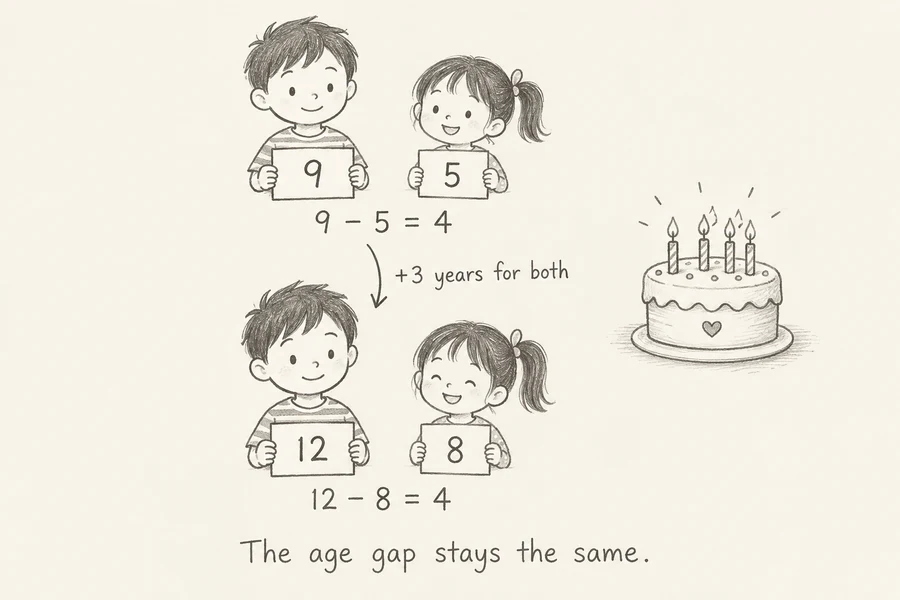
Constant difference
The gap between the two amounts never changes.
How to spot it & common mistakes
How to spot it
Both amounts go up or down by the same amount. Ages are the common case, because the same number of years passes for both people.
Common mistake
Children treat the gap as fixed when only one person changed, forgetting that adding to one person alone moves the gap by exactly that amount.
P6
Everything changed
Both amounts change, so no total and no gap stays fixed.
How to spot it & common mistakes
How to spot it
Both people in a ratio change by different amounts, with words like 'joined' or 'saved more' for one and 'left' or 'spent' for the other.
Common mistake
Children look for a fixed total or a fixed gap out of habit. Neither is fixed here, so only the ratio at the end can give the size of a share.
P3 · P4 · P5 · P6
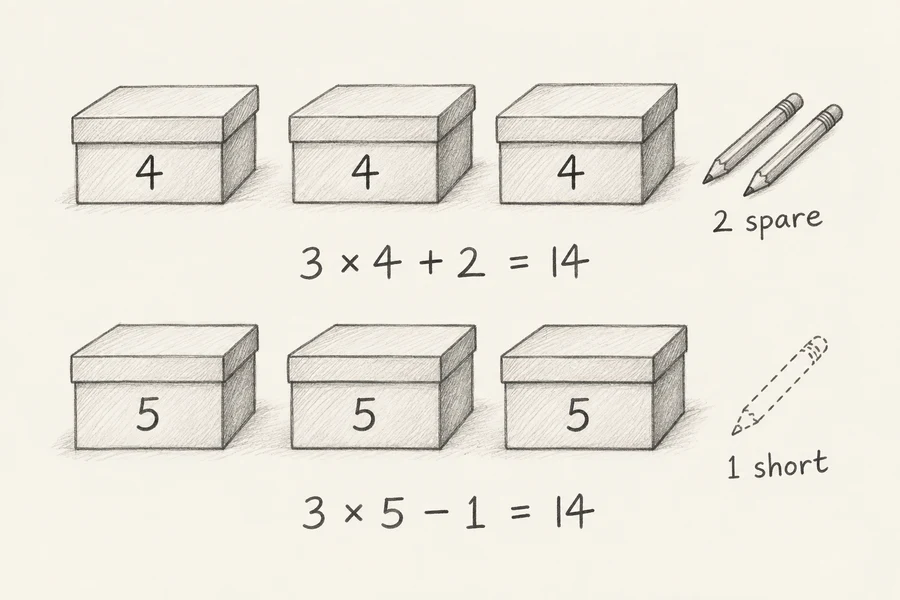
Gap and difference
Share the same things two ways. One way leaves too many, the other too few.
How to spot it & common mistakes
How to spot it
Objects are grouped two different ways with a leftover in one arrangement and a shortage in the other, using words like 'left over' and 'short of'.
Common mistake
Children combine the leftover and the shortfall in the wrong direction. The gap must then be divided by the difference in group size, not by either group size.
P4 · P5 · P6
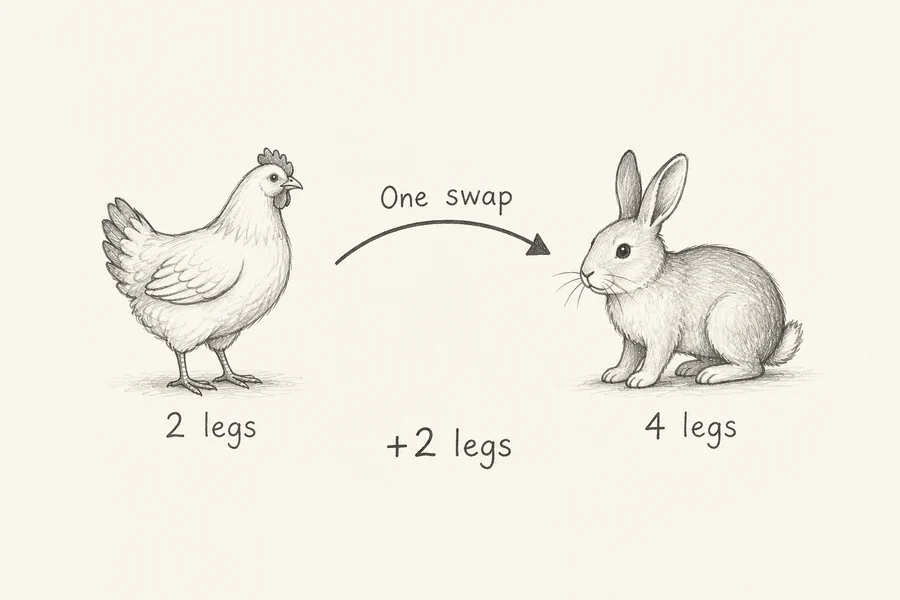
Suppose and swap
Suppose everything is one kind, then swap one at a time until the total is right.
How to spot it & common mistakes
How to spot it
Two kinds of thing are mixed together with a known total count and a known total of something else, such as legs or sweets, and neither kind's count is given on its own.
Common mistake
Children lose track of whether a swap adds to the total or takes away from it. Compare the starting total with the target first, then swap in the direction that closes the gap.
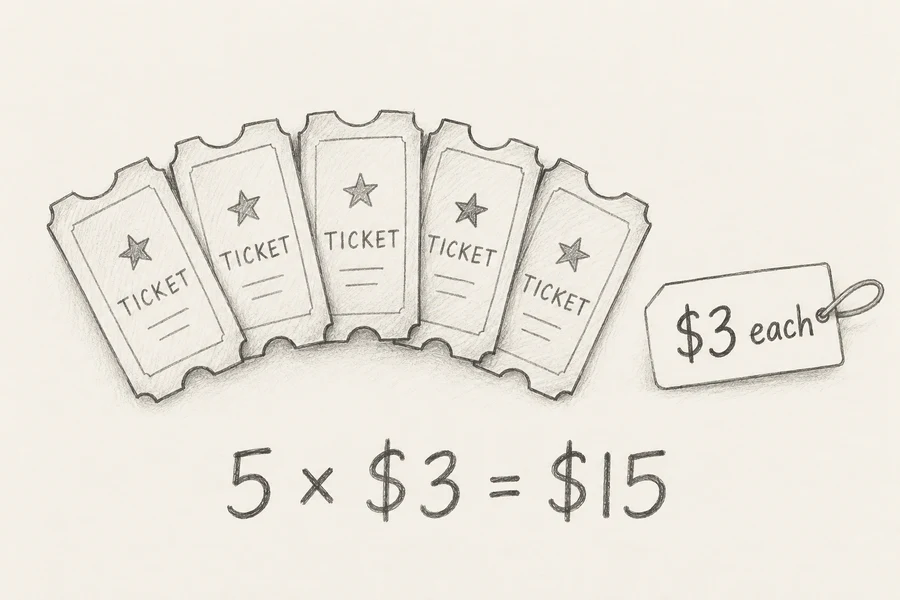
P5 · P6
Number × value
One batch repeats. Work out one batch, then multiply.
How to spot it & common mistakes
How to spot it
Items are described as a fixed group or ratio that repeats, such as tiles following a pattern, snacks sold in a fixed mix, or a rate given per hour or per item.
Common mistake
Children start from the grand total instead of first working out what one batch is worth. In rate questions they also confuse a duration with a clock time.
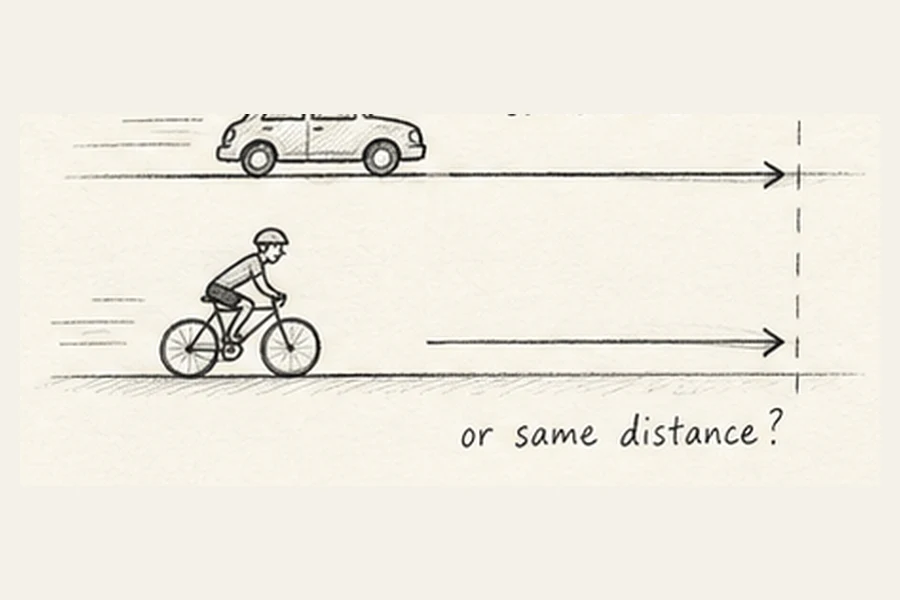
P6
Same time, same distance
Two travellers spend the same time, or cover the same distance.
How to spot it & common mistakes
How to spot it
Two travellers set off together or one chases another, with constant speeds and a question about who is ahead, when they meet, or how far apart they are.
Common mistake
Children divide the whole distance by the difference in speed instead of dividing the gap between the travellers, or compare distances covered over different lengths of time.
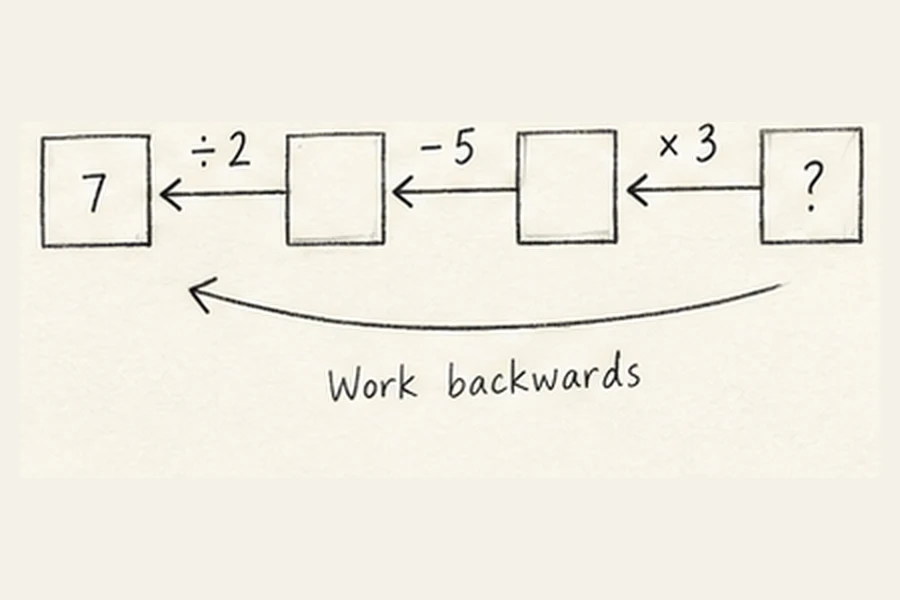
P3 · P4 · P5 · P6
Working backwards
You know how it ended. Undo each step, last one first.
How to spot it & common mistakes
How to spot it
The question gives the final amount after a sequence of changes and asks what the amount was 'at first' or 'to begin with'.
Common mistake
Children undo the steps in the same order they happened rather than in reverse, or forget that a percentage profit is added to the cost price, so the final price is 120% of it, not 100%.
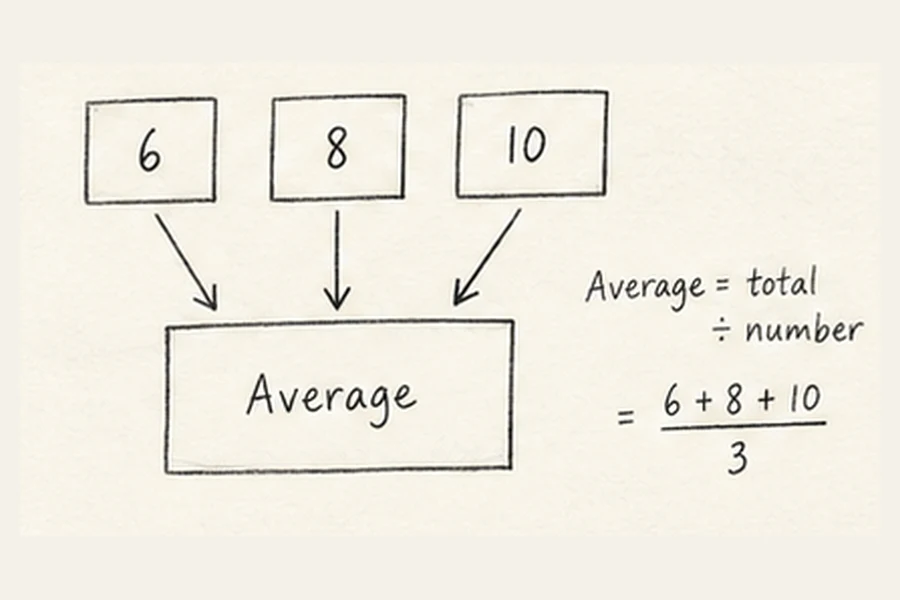
P6
An average is a total
Turn the average back into a total before doing anything with it.
How to spot it & common mistakes
How to spot it
The word 'average' appears alongside a group being split into two parts, or two separate journeys or trips being combined into one overall figure.
Common mistake
Children average two averages directly, such as averaging two speeds or two group averages, without weighting by how many, or how long, each part actually covers.
P3 · P4 · P5 · P6
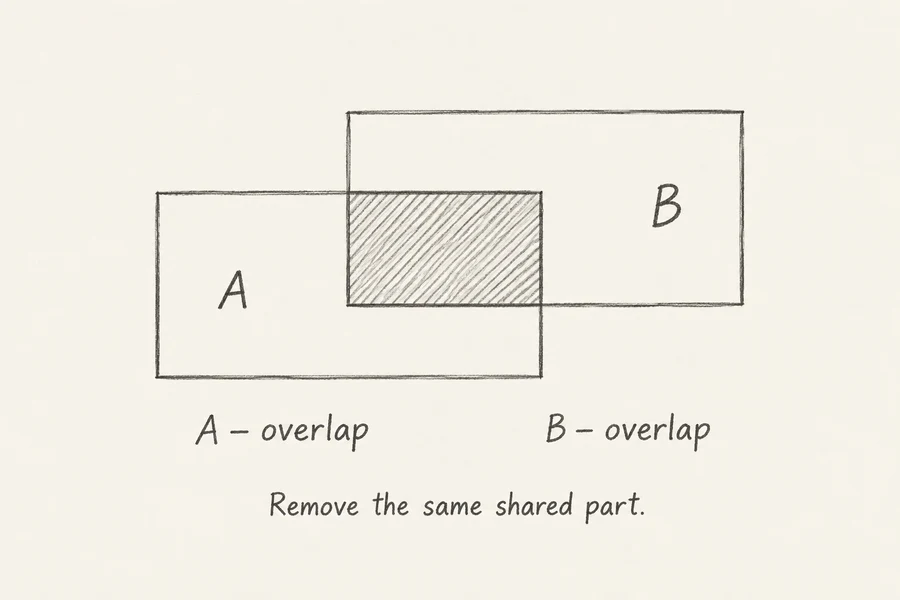
Overlap and cancel
Two shapes share a region, and the shared part cancels out.
How to spot it & common mistakes
How to spot it
Shapes are joined, stacked, or have a piece cut off, and the question compares a perimeter or length before and after, rather than asking for an area from scratch.
Common mistake
Children assume perimeter changes the same way area does. Joining shapes or cutting off a corner can leave the perimeter unchanged, or change it by a different amount from the area.
P5 · P6
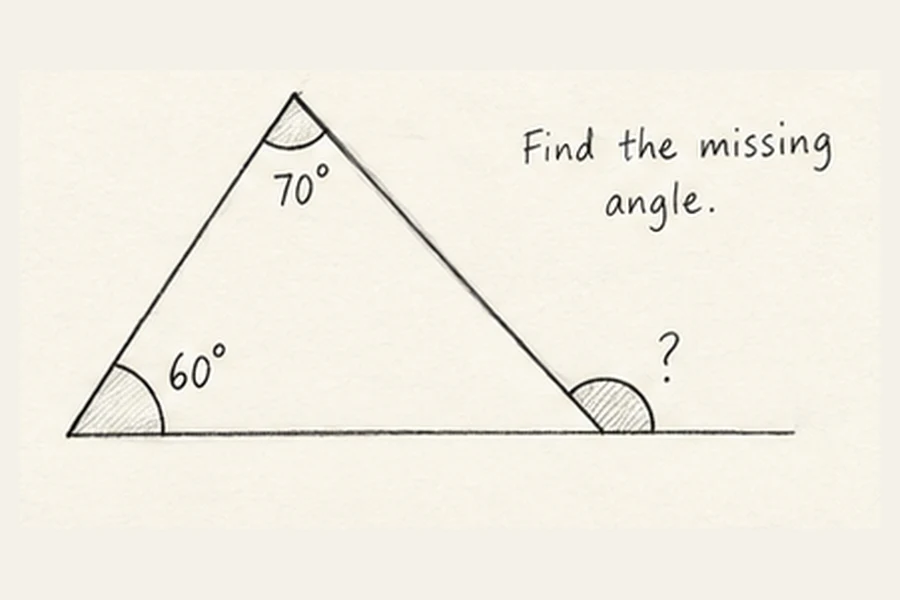
Angle chasing
One angle gives you the next, until you reach the angle asked for.
How to spot it & common mistakes
How to spot it
A figure has several angles marked with only one or two values given, and words like 'isosceles', 'parallel', or 'straight line' point to which rule to use first.
Common mistake
Children apply an angle rule to the wrong triangle or the wrong straight line in a crowded figure, or stop one step before the angle actually asked for.
P1 · P2 · P3 · P4 · P5 · P6
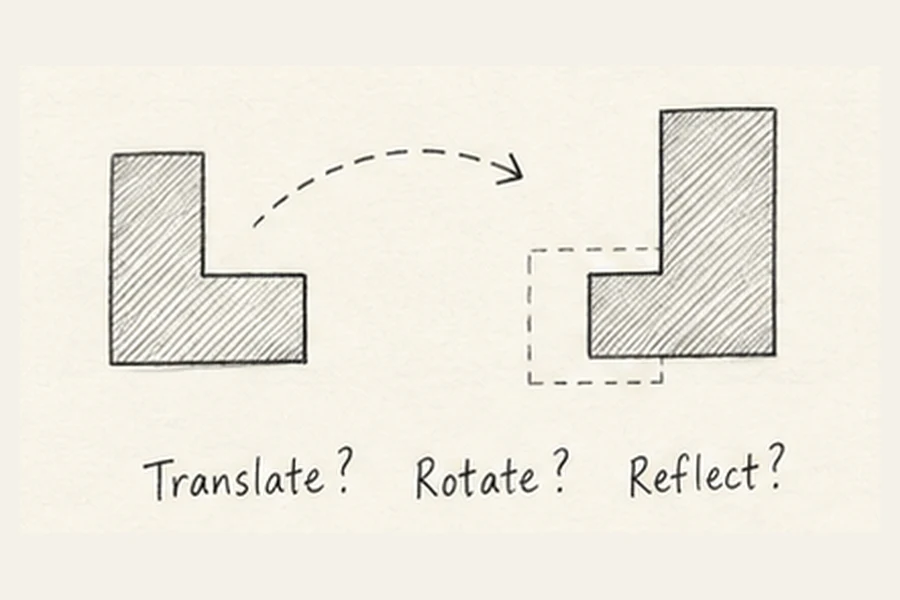
Seeing it move
Work out where the pieces land after a fold, cut or stack.
How to spot it & common mistakes
How to spot it
Words like 'folded', 'cut along the dotted line' or 'stacked' appear beside a shape, and the question asks for a length or angle that only makes sense once the pieces are in their new positions.
Common mistake
Children try to calculate the answer before working out where the pieces actually end up, skipping the visualisation step that the whole question depends on.
P4 · P5 · P6
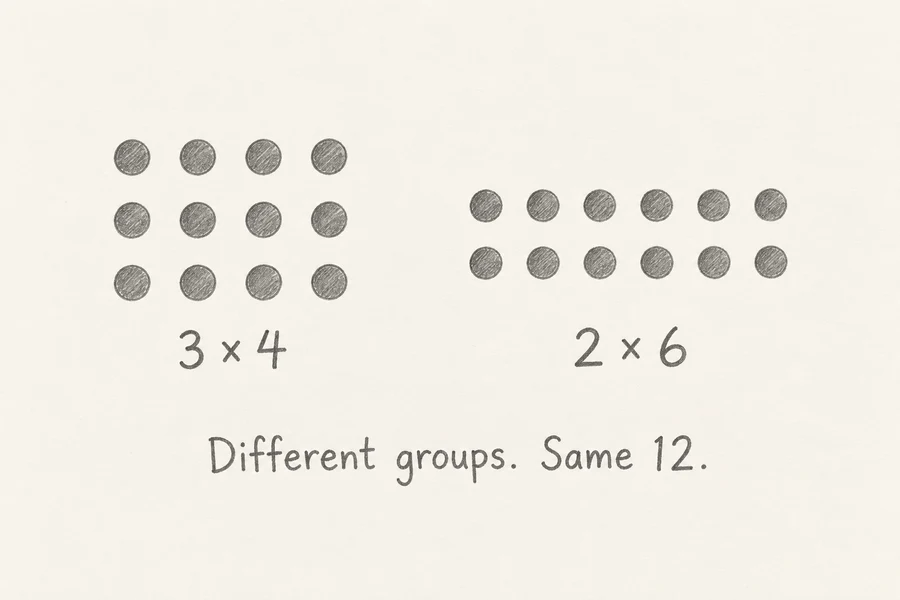
Factors and multiples
The answer comes from how the numbers divide, not from a bar model.
How to spot it & common mistakes
How to spot it
Words like 'as many teams as possible', 'equally divided with none left over', or 'has exactly this many factors' appear, without any ratio or fraction in sight.
Common mistake
Children reach for the lowest common multiple when the question needs the highest common factor, or try to list every factor of a number by hand instead of building it from its prime factors.
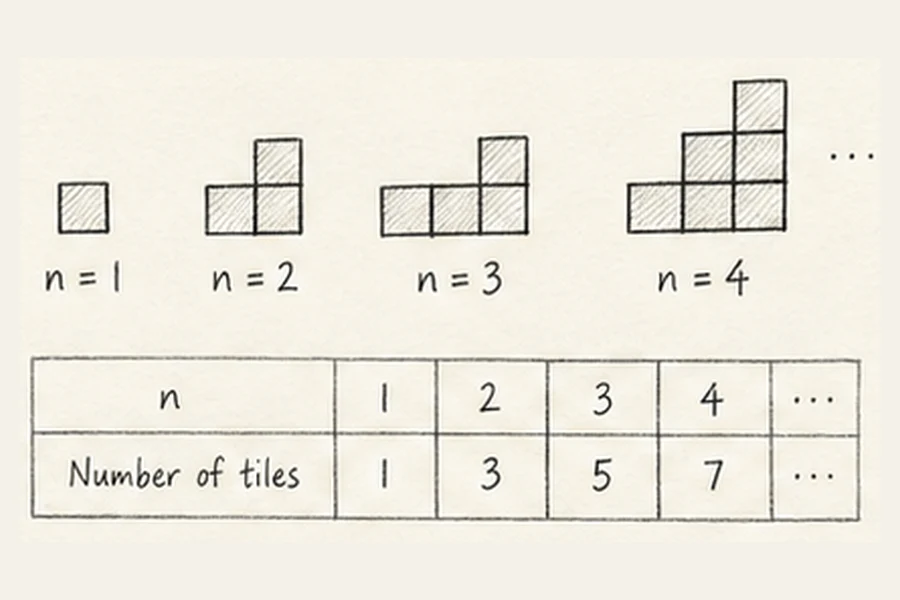
P1 · P2 · P3 · P4 · P5 · P6
Growing patterns and tables
Find the rule, so Figure 250 is no harder than Figure 4.
How to spot it & common mistakes
How to spot it
A row of figures or a table of numbers is shown for the first few terms only, and the question asks for a term far further along, such as 'Figure 6' or 'Figure 250'.
Common mistake
Children extend the sequence one term at a time by drawing or counting. Finding the fixed step or relationship lets them jump straight to the term asked for.
The 33 problem patterns
All 33 patterns, one to a page — the 19 behind Primary 5 and 6 word problems, and the skills the younger years are built on. The bar model, how to spot it in the question, and the mistake children make. A booklet you can print. Free.