The pattern
P5 fraction foundations
Translate division into a fraction, then calculate exactly with mixed and improper fractions.
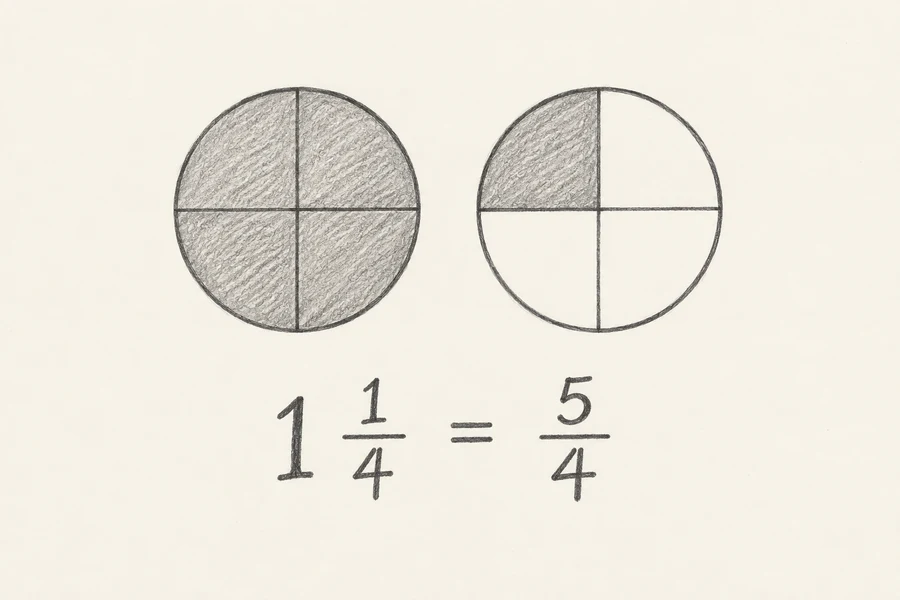
Two fractions with different denominators describe different sized pieces, a third and a sixth are not the same size slice, so they cannot be added until both are rewritten using the same size piece. Once the denominators match, only the numerators need combining. The same rewriting lets two fractions be compared, since it is easier to see which is bigger once both are cut into the same number of pieces.
How to spot it
Two fractions with different denominators to add or compare, or a mixed number to calculate with, point here.
Common mistake
Children add or compare the numerators straight away without rewriting the denominators to match first, treating a third plus a sixth as two sevenths.
38 worked solutions
Standard
- add fractions Calculate 3/5 + 1/2.
- add fractions Calculate 1/4 + 2/3.
- Add mixed numbers — 1 3/4 and 2 2/4 Calculate 1 3/4 + 2 2/4.
- Add mixed numbers — 2 1/3 and 1 2/3 Calculate 2 1/3 + 1 2/3.
- add related fractions Calculate 3/8 + 1/4.
- add related fractions Calculate 1/3 + 1/6.
- compare unlike fractions Compare 3/5 and 5/8 using < or >.
- compare unlike fractions Compare 2/3 and 3/4 using < or >.
- convert an improper fraction Convert 22/6 to a mixed number in simplest form.
- convert an improper fraction Convert 17/5 to a mixed number in simplest form.
- Division as a fraction — 11 ÷ 4 Express 11 ÷ 4 as a fraction. Give the answer in its simplest form and as a mixed number if needed.
- Division as a fraction — 7 ÷ 4 Express 7 ÷ 4 as a fraction. Give the answer in its simplest form and as a mixed number if needed.
- find a missing denominator Complete: 3/5 = 12/__.
- find a missing denominator Complete: 2/3 = 8/__.
- find a missing numerator Complete: 3/5 = __/20.
- find a missing numerator Complete: 2/3 = __/12.
- Fraction to decimal — 3/4 Convert 3/4 to decimal form.
- Fraction to decimal — 7/8 Convert 7/8 to decimal form.
- Improper fraction × whole number Calculate 9/5 × 10.
- Improper fraction × whole number Calculate 7/4 × 8.
- interpret an improper fraction Explain 13/5 as whole groups and a remaining fraction.
- interpret an improper fraction Explain 11/4 as whole groups and a remaining fraction.
- Mixed number × whole number Calculate 2 1/3 × 6.
- Mixed number × whole number Calculate 1 3/4 × 8.
- Proper fraction × improper fraction Calculate 3/4 × 10/9.
- Proper fraction × improper fraction Calculate 2/5 × 15/4.
- recognise equivalent fractions Write a fraction equivalent to 3/5 using denominator 15.
- recognise equivalent fractions Write a fraction equivalent to 2/3 using denominator 12.
- reduce a fraction to simplest form Express 15/25 in simplest form.
- reduce a fraction to simplest form Express 12/18 in simplest form.
- subtract fractions Calculate 7/8 − 1/3.
- subtract fractions Calculate 4/5 − 2/7.
- Subtract mixed numbers Calculate 5 1/4 − 2 2/3.
- Subtract mixed numbers Calculate 4 1/3 − 1 3/4.
- subtract related fractions Calculate 7/8 − 1/4.
- subtract related fractions Calculate 5/6 − 1/3.
- Two improper fractions Calculate 7/4 × 10/3.
- Two improper fractions Calculate 5/3 × 9/4.
The 33 problem patterns
All 33 patterns, one to a page — the 19 behind Primary 5 and 6 word problems, and the skills the younger years are built on. The bar model, how to spot it in the question, and the mistake children make. A booklet you can print. Free.