The pattern
Angle chasing
One angle gives you the next, until you reach the angle asked for.
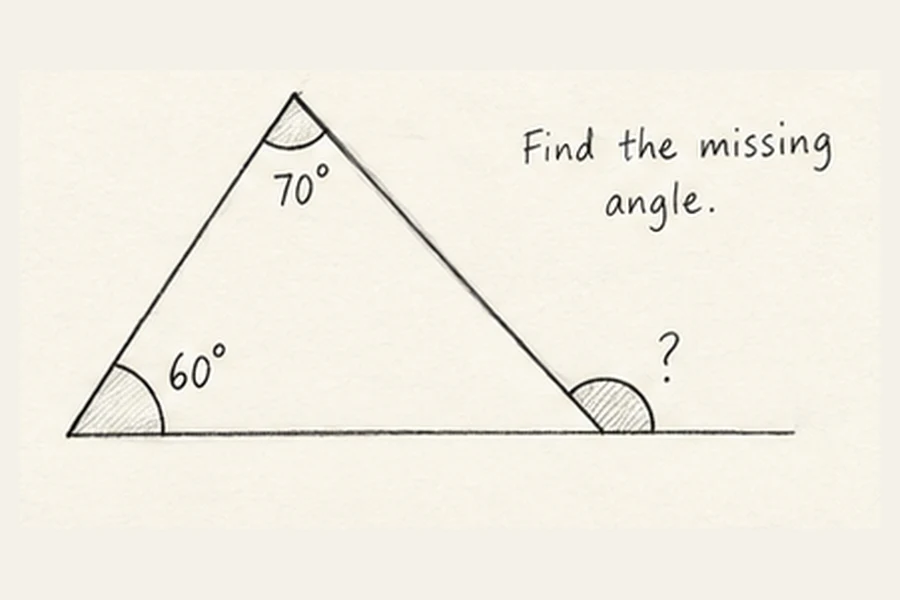
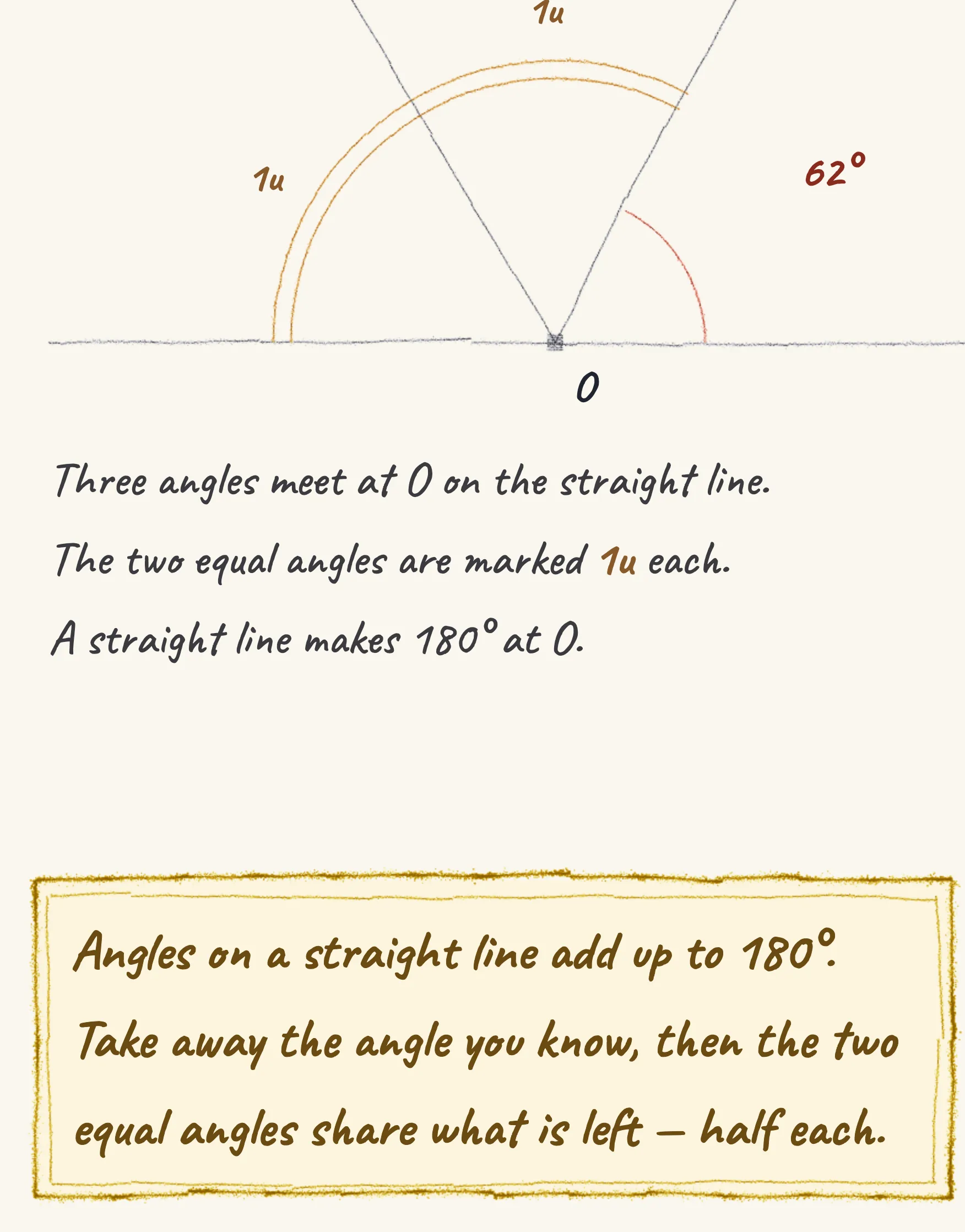
No one rule hands you the angle asked for. You get there a step at a time: a triangle adds to 180 degrees, the base angles of an isosceles triangle are equal, angles on a straight line add to 180. Each angle you work out lets you work out the next, until the chain reaches the one you were asked for.
How to spot it
A figure has several angles marked with only one or two values given, and words like 'isosceles', 'parallel', or 'straight line' point to which rule to use first.
Common mistake
Children apply an angle rule to the wrong triangle or the wrong straight line in a crowded figure, or stop one step before the angle actually asked for.
6 worked solutions
Standard
- Angles on a line — two equal ones and 62° Two equal angles sit on a straight line together with a third angle of 62 degrees. Find the size of each equal angle.
- Triangle PQR — angle Q is twice angle R In triangle PQR, angle P = 48 degrees and angle Q is twice angle R. Find the size of angle R.
Challenging
- A display easel — angle EAB A framer is building a triangular display easel EAD, braced by a parallelogram strut BCDE, where B lies on strut AD. The two strut…
- A kite skeleton — angle EAB A kite maker cuts a triangular kite skeleton EAD from bamboo, with a parallelogram sail panel BCDE stitched across it; B lies on t…
- A trellis and a lattice — angle EAB A landscaper installs a triangular trellis EAD in a garden bed, with a parallelogram lattice panel BCDE fitted inside it; B lies o…
- Parallelogram BCDE — find ∠EAB EAD is a triangle and BCDE is a parallelogram, with AB = BE. Given ∠DBC = 39° and ∠BCD = 73°, find ∠EAB.
The 33 problem patterns
All 33 patterns, one to a page — the 19 behind Primary 5 and 6 word problems, and the skills the younger years are built on. The bar model, how to spot it in the question, and the mistake children make. A booklet you can print. Free.