Today’s problem — free all day, every step. Every day has one.
PSLE 2025 — Ginger and onions
100 g of ginger costs the same as 320 g of onions. It costs $6.20 for 400 g of ginger and 1.2 kg of onions. How much is 100 g of ginger?
Show the answerHide the answer
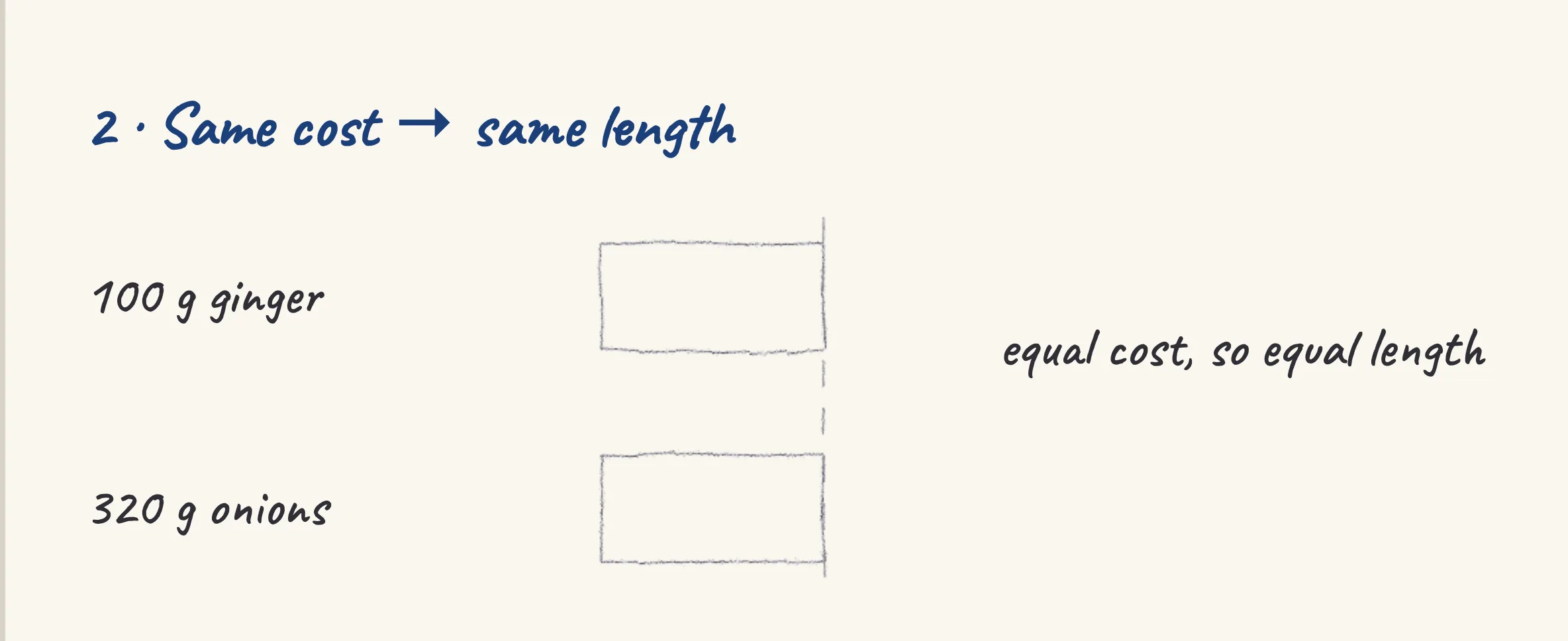
See all 9 steps
MathBrush is being tested with a few parent groups, and every solution on the site is open to them — one household, all children. If you were given a code, it goes in once and this device remembers it.
I have a code → See a free one like it
65 worked examples are free without a code, two from every pattern. No account, either way.
The pattern behind it: The equal concept
The question tells you a part of one pile equals a part of another.
In this one. Ginger and onions are two currencies with a fixed exchange rate — swap the ginger for the onions it is worth, and the whole $6.20 is buying just one thing.
How to spot it
Two different groups each get their own fraction or percentage, and the question links them with 'the same as', 'twice as many as', or a shared cost across different units.
Common mistake
Children compare the two fractions without first relating them to a common whole. A smaller fraction of a larger group can be bigger than a larger fraction of a smaller group.
Try one like it
Standard Files and pens — the cost of 1 pen The total cost of 2 identical files and 1 pen is $19.05. The total cost of 3 such files and 5 such pens is $44.50. Find the cost o…The 33 problem patterns
All 33 patterns, one to a page — the 19 behind Primary 5 and 6 word problems, and the skills the younger years are built on. The bar model, how to spot it in the question, and the mistake children make. A booklet you can print. Free.
A PDF, and a note when new solutions go up.