The pattern
Decimals and percentages
Keep place values and the whole visible while scaling decimals or finding a percentage.
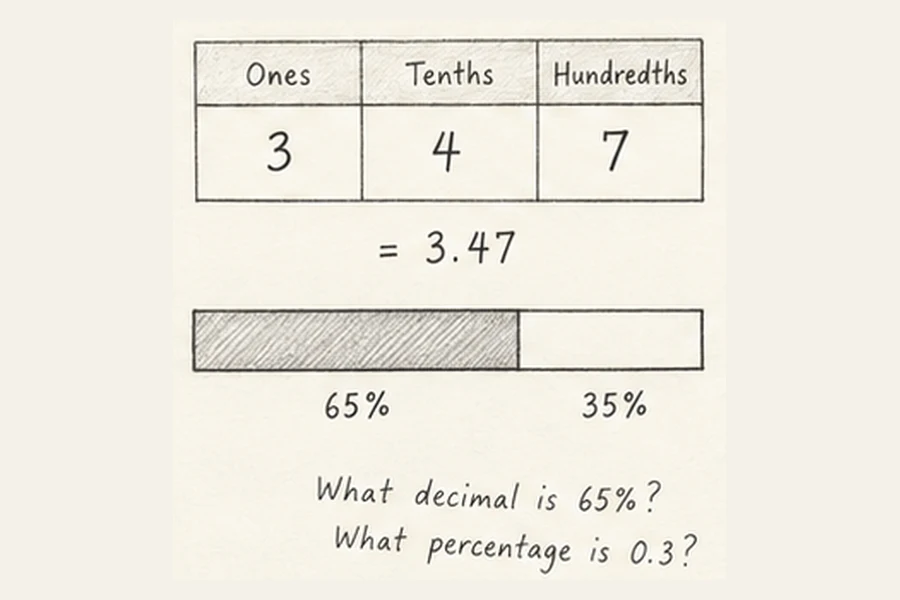
Every measurement carries two clues: what is being measured, length, mass, or capacity, and how big the object is. A pencil is measured in centimetres because kilometres would swallow it whole; a child's mass needs kilograms, since millilitres measure liquid, not weight. The same attention to matching reads a clock correctly, separating hours from minutes, and turns a percentage or a decimal into the right number of places.
How to spot it
The question offers two possible units for the same kind of measurement, such as cm or km, or asks to read a time or a percentage from a picture.
Common mistake
Children pick the unit that sounds familiar rather than the one that fits the object's size, or read a clock's hour and minute hands the wrong way round.
102 worked solutions
Standard
- add decimals Calculate 3.25 + 1.875.
- add decimals Calculate 2.375 + 1.45.
- add money amounts Calculate $3.75 + $2.48.
- add money amounts Calculate $12.65 + $5.87.
- choose a measurement unit Choose the suitable abbreviation for a child’s mass: kg or mL?
- choose a measurement unit Choose the suitable abbreviation for a pencil’s length: cm or km?
- choose kilometres for distance Which unit is more suitable for the length of a cross-country route: metres or kilometres?
- choose kilometres for distance Which unit is more suitable for the distance between two towns: metres or kilometres?
- choose millilitres for liquid volume Which unit is more suitable for the juice in a small cup: litres or millilitres?
- choose millilitres for liquid volume Which unit is more suitable for the liquid in a medicine spoon: litres or millilitres?
- compare and order decimals Arrange 7.25, 7.025 and 7.205 in ascending order.
- compare and order decimals Arrange 3.25, 3.205 and 3.52 in ascending order.
- compare lengths Which is greater: 320 cm or 275 cm?
- compare lengths Which is greater: 235 cm or 180 cm?
- compare masss Which is greater: 3250 g or 2900 g?
- compare masss Which is greater: 2400 g or 1750 g?
- compare money amounts Arrange $6.75, $7.05 and $6.50 from least to greatest.
- compare money amounts Arrange $4.25, $3.90 and $5.10 from least to greatest.
- compare volumes Which is greater: 8 L or 6 L?
- compare volumes Which is greater: 5 L or 3 L?
- convert a decimal to a fraction Express 4.2 as a fraction in simplest form.
- convert a decimal to a fraction Express 3.75 as a fraction in simplest form.
- convert a fraction to a decimal Express 3/4 as a decimal.
- convert a fraction to a decimal Express 13/20 as a decimal.
- convert dollars and cents Express $6.70 in cents.
- convert dollars and cents Express $4.25 in cents.
- convert hours and minutes to minutes Express 3 h 20 min in minutes.
- convert hours and minutes to minutes Express 2 h 35 min in minutes.
- convert kg and g Express 4.305 kg in g.
- convert kg and g Express 2.75 kg in g.
- convert km and m Express 4.805 km in m.
- convert km and m Express 3.25 km in m.
- convert L and mL Express 3.75 L in mL.
- convert L and mL Express 2.25 L in mL.
- convert m and cm Express 7.38 m in cm.
- convert m and cm Express 4.25 m in cm.
- count mixed dollars and cents A purse has $3.25 and $2.60. How much is there altogether?
- count mixed dollars and cents A purse has $2.35 and $1.40. How much is there altogether?
- decimal divide Calculate 67.2 ÷ 300.
- decimal divide Calculate 144 ÷ 200.
- decimal multiply Calculate 3.48 × 200.
- decimal multiply Calculate 1.25 × 300.
- discount Find the discount on $240 at 15%.
- discount Find the discount on $120 at 25%.
- divide a decimal Calculate 9.6 ÷ 6.
- divide a decimal Calculate 7.224 ÷ 4.
- express a measurement in compound units Express 3708 m in kilometres and metres.
- express a measurement in compound units Express 2345 m in kilometres and metres.
- express whole-number division as a decimal Express 9 ÷ 4 as a decimal.
- express whole-number division as a decimal Express 7 ÷ 8 as a decimal.
- find a finishing time An activity started at 09:35 and lasted 85 minutes. When did it finish?
- find a finishing time An activity started at 13:20 and lasted 55 minutes. When did it finish?
- find elapsed duration How much time passes from 09:25 to 11:05?
- find elapsed duration How much time passes from 14:40 to 16:15?
- gst Find the stated GST on $400 at 9%.
- gst Find the stated GST on $200 at 9%.
- identify decimal place value In 7.245, what is the value of the digit 2?
- identify decimal place value In 4.582, what is the value of the digit 8?
- interest Find the annual interest on $800 at 3%.
- interest Find the annual interest on $1200 at 4%.
- interpret percent Explain what 48% means.
- interpret percent Explain what 35% means.
- km to m Express 3.075 km in metres.
- km to m Express 2.425 km in metres.
- litre to ml Express 1.75 litres in millilitres.
- litre to ml Express 2.25 litres in millilitres.
- m to cm Express 4.26 m in centimetres.
- m to cm Express 3.75 m in centimetres.
- measure hours and minutes A trip lasts 3 hours and 20 minutes. State its duration in hours and minutes.
- measure hours and minutes A trip lasts 2 hours and 35 minutes. State its duration in hours and minutes.
- measure length in metres Which unit is suitable for the height of a doorway: metres or centimetres?
- measure length in metres Which unit is suitable for the length of a classroom: metres or centimetres?
- measure liquid volume in litres Which unit is suitable for the juice in a large jug: litres or millilitres?
- measure liquid volume in litres Which unit is suitable for the water in a bucket: litres or millilitres?
- measure mass in kilograms or grams Which unit is suitable for the mass of a watermelon: kilograms or grams?
- measure mass in kilograms or grams Which unit is suitable for the mass of a schoolbag: kilograms or grams?
- measure time in seconds Express 3 min 25 s in seconds.
- measure time in seconds Express 2 min 15 s in seconds.
- multiply a decimal Calculate 2.375 × 6.
- multiply a decimal Calculate 1.25 × 7.
- part as percent 24 of 80 pupils chose chess. What percentage is that?
- part as percent 18 of 60 pupils chose chess. What percentage is that?
- read an analogue clock to the minute The shown analogue clock is on a classroom wall. What time does it display?
- read an analogue clock to the minute The shown analogue clock is at a bus stop. What time does it display?
- read decimal money notation Write 670 cents using dollar notation.
- read decimal money notation Write 425 cents using dollar notation.
- read the 24-hour clock Write 19:05 in 12-hour time.
- read the 24-hour clock Write 14:35 in 12-hour time.
- represent a decimal Represent 7.084 as a sum of place values.
- represent a decimal Represent 3.407 as a sum of place values.
- round a calculated decimal Calculate 7 ÷ 6 and round the answer to 2 decimal places.
- round a calculated decimal Calculate 22 ÷ 9 and round the answer to 2 decimal places.
- round a decimal to 1 decimal place Round 7.501 to 1 decimal place.
- round a decimal to 1 decimal place Round 4.687 to 1 decimal place.
- round a decimal to 2 decimal places Round 7.501 to 2 decimal places.
- round a decimal to 2 decimal places Round 4.687 to 2 decimal places.
- round a decimal to nearest whole number Round 7.501 to nearest whole number.
- round a decimal to nearest whole number Round 4.687 to nearest whole number.
- subtract decimals Calculate 9.14 − 4.25.
- subtract decimals Calculate 5.825 − 2.475.
- subtract money amounts Calculate $9.00 − $3.65.
- subtract money amounts Calculate $20.00 − $12.75.
The 33 problem patterns
All 33 patterns, one to a page — the 19 behind Primary 5 and 6 word problems, and the skills the younger years are built on. The bar model, how to spot it in the question, and the mistake children make. A booklet you can print. Free.