The pattern
Gap and difference
Share the same things two ways. One way leaves too many, the other too few.
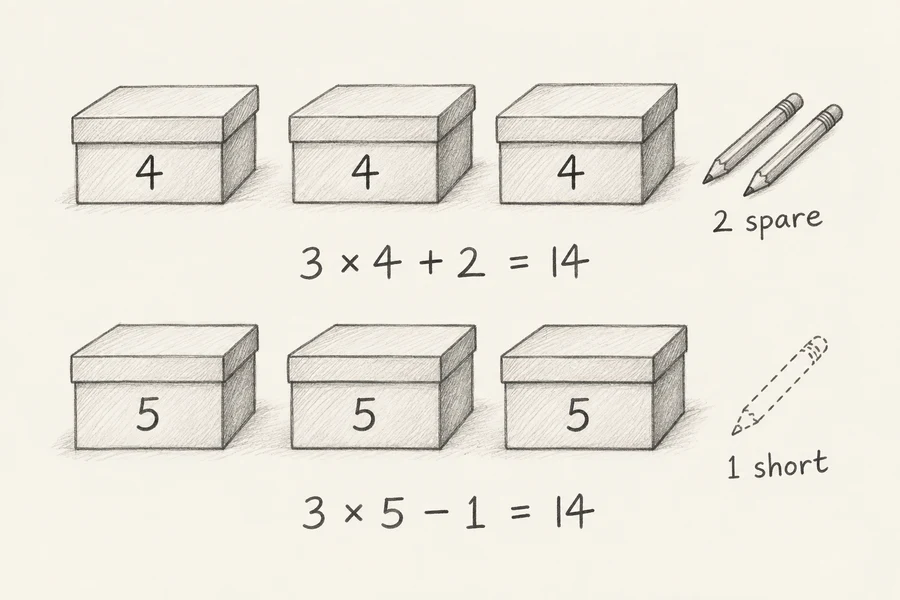
The same collection is arranged two ways, chairs into rows or pencils into boxes, and one arrangement leaves too many while the other leaves too few. The swing from too many to too few is a countable gap, built up in fixed steps. Divide that gap by the size of one step to get the number of rows.
How to spot it
Objects are grouped two different ways with a leftover in one arrangement and a shortage in the other, using words like 'left over' and 'short of'.
Common mistake
Children combine the leftover and the shortfall in the wrong direction. The gap must then be divided by the difference in group size, not by either group size.
6 worked solutions
Challenging
- Chairs — rearranged into rows of 7 In a school hall, chairs were arranged in rows such that there were exactly 9 chairs in each row. For a concert, Mr Ong brought 6 …
- Flower pots rearranged in rows — the nursery In a garden nursery, flower pots were arranged in rows with exactly 15 pots in each row. The gardener bought 10 more pots and rear…
- Gap & Difference Eggsellers A and B have the same number of eggs. A puts 30 on every tray and uses them all up; B puts 25 on every tray, needs 6 mo…
- Library shelves — more books, fewer per shelf In a library, books were arranged on shelves with exactly 8 books on each shelf. The librarian brought 4 more books into the libra…
- Pencils — boxes of 6 leave some over, boxes of 8 fall short A teacher packs pencils into boxes of 6 and has 4 pencils left over. If she uses boxes of 8, she is short of 6 pencils. How many p…
- Storybooks packed into boxes of 5 and 7 A librarian packs storybooks into boxes of 5, with 3 books left over. If she packs them into boxes of 7 instead, she is short of 5…
1 more that use it
Filed under a different pattern, but this one is part of the working.
The 33 problem patterns
All 33 patterns, one to a page — the 19 behind Primary 5 and 6 word problems, and the skills the younger years are built on. The bar model, how to spot it in the question, and the mistake children make. A booklet you can print. Free.