The pattern
Work backwards from volume or area
Use the known area or volume to find the missing measurement.
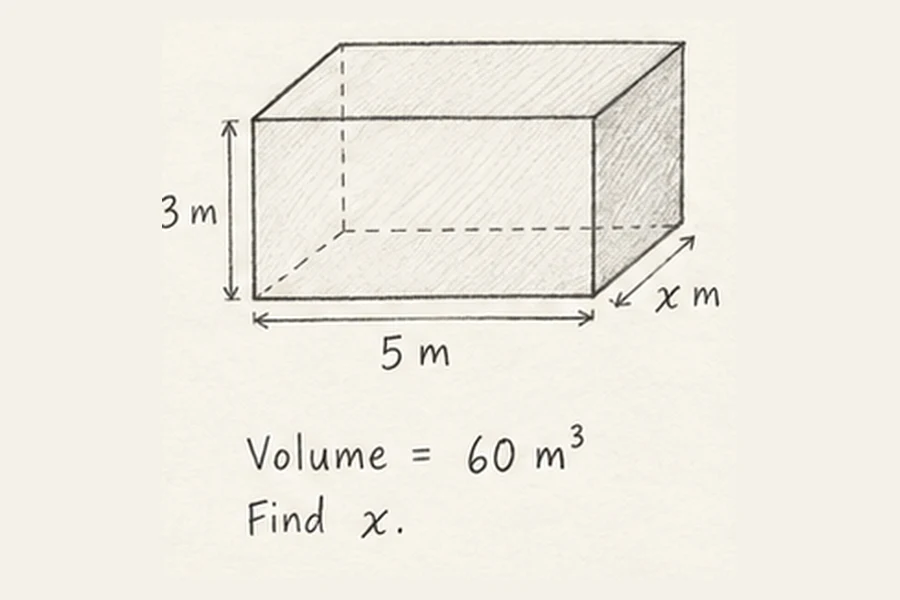
Volume equals length times width times height. When the volume and two of the three are known, dividing the volume by those two multiplied together gives the missing one. Finding an unknown face's area works the same way: divide the volume by the length running perpendicular into that face, not by a length lying inside it. A square's side undoes the same multiplication, asking what number times itself gives the known area.
How to spot it
The question gives a cuboid's volume with two dimensions and asks for the third, or gives the volume with one length and asks for a face area. A square's area given with its side asked for belongs here too.
Common mistake
Children divide the volume by a length lying inside the face they want, instead of the length that runs into it, and get the wrong kind of measurement.
6 worked solutions
Standard
- A square with area 100 cm² A square has area 100 cm². Write its side length using square-root notation, then evaluate it.
- A square with area 64 cm² A square has area 64 cm². Write its side length using square-root notation, then evaluate it.
- Cuboid face area — volume 384 cm³ A cuboid has volume 384 cm³ and depth 8 cm. Find the area of the face perpendicular to that depth.
- Cuboid face area — volume 480 cm³ A cuboid has volume 480 cm³ and depth 10 cm. Find the area of the face perpendicular to that depth.
- Cuboid height — volume 240 cm³ A cuboid has volume 240 cm³, length 10 cm and width 6 cm. Find its height.
- Cuboid height — volume 480 cm³ A cuboid has volume 480 cm³, length 15 cm and width 8 cm. Find its height.
The 33 problem patterns
All 33 patterns, one to a page — the 19 behind Primary 5 and 6 word problems, and the skills the younger years are built on. The bar model, how to spot it in the question, and the mistake children make. A booklet you can print. Free.