The pattern
Overlap and cancel
Two shapes share a region, and the shared part cancels out.
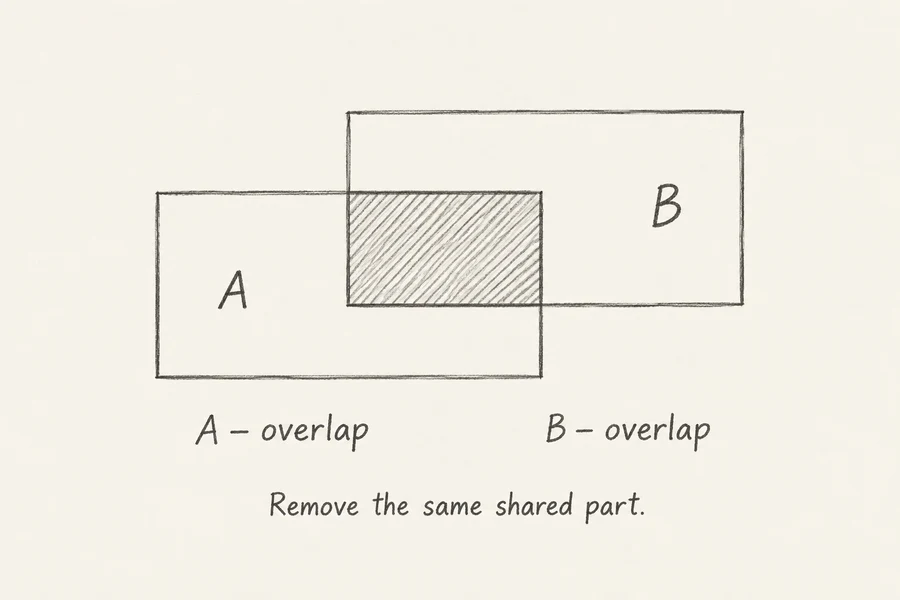
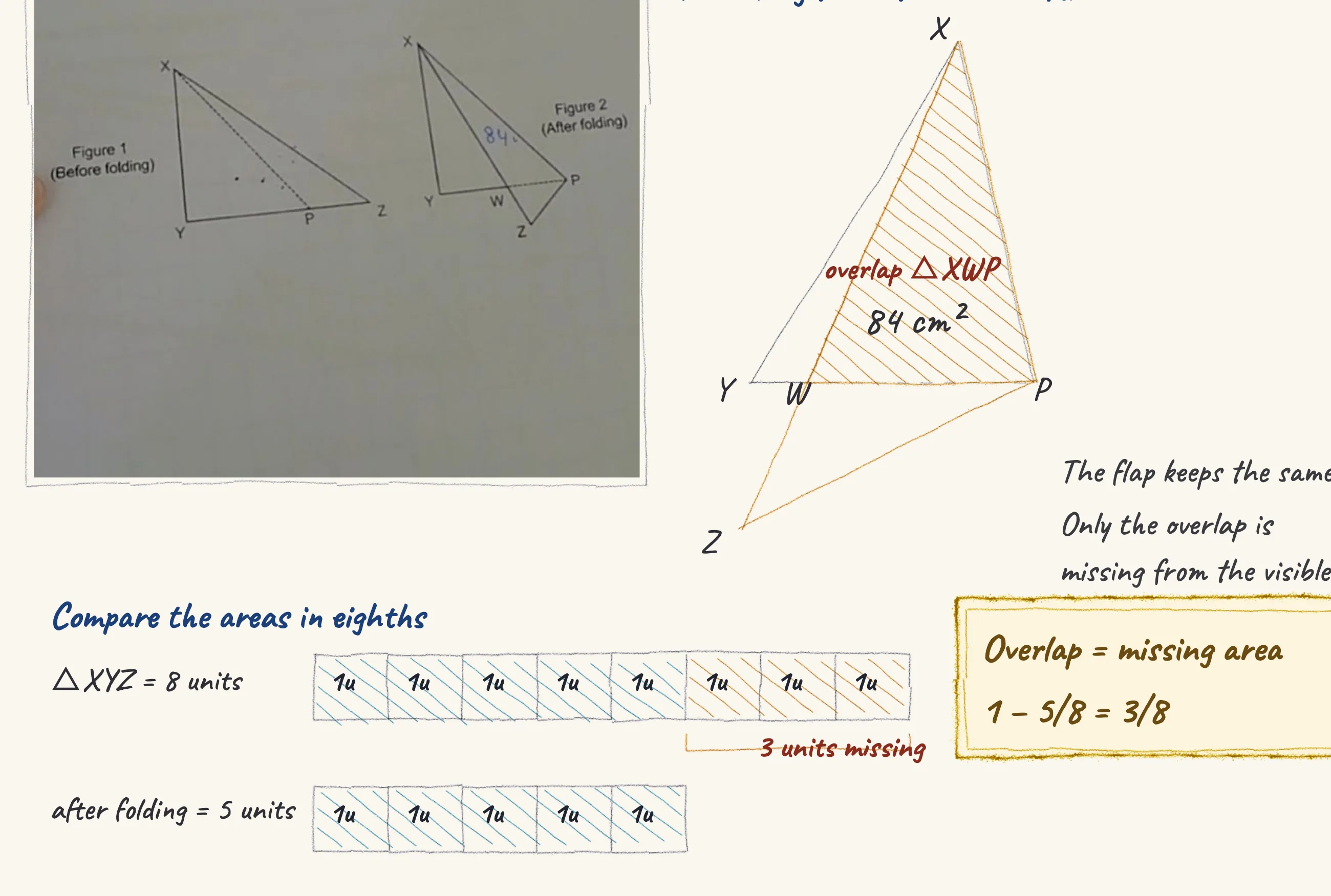
When two shapes share a region, that shared part counts the same on both sides, so it cancels out of the comparison. Joining two shapes edge to edge moves an edge from the outside to the inside, and the drop in perimeter tells you how much edge went in. Cutting a corner off removes area but leaves the perimeter alone.
How to spot it
Shapes are joined, stacked, or have a piece cut off, and the question compares a perimeter or length before and after, rather than asking for an area from scratch.
Common mistake
Children assume perimeter changes the same way area does. Joining shapes or cutting off a corner can leave the perimeter unchanged, or change it by a different amount from the area.
15 worked solutions
Standard
- Area of triangle Two identical right-angled triangles overlap. Their perpendicular sides are 12 cm and 18 cm; the shaded parts total 132 cm². Find …
- Folding shape A triangular piece of paper XYZ is folded along XP. The visible figure after folding is 5/8 of triangle XYZ, and the overlap trian…
Challenging
- Five semicircles on a line — the diameter Five identical semicircles sit on one straight line — three above it, two below.
- Garden PQRS — the path and the shaded triangles A rectangular garden PQRS is divided into two rectangular beds by a straight path UV, where U is on PQ and V is on SR (so PUVS and…
- Library hall — the partition and the shaded triangles A rectangular library hall JKLM is divided into two reading rooms by a glass partition NO, where N is on JK and O is on ML (so JNO…
- Overlapping squares Two different squares overlap in an unshaded square. Their full width is 10 cm, and shaded area A is 24 cm² greater than shaded ar…
- Paper flags — two strings, one courtyard Two strings of identical paper flags are hung across a courtyard, each string tied from the same starting wall to the same opposit…
- PSLE 2023 — Three trapeziums perimeter The perimeter of one trapezium is 96 cm. Three identical trapeziums are joined edge to edge to form a figure whose perimeter is 20…
- PSLE overlapping shapes 4 identical semicircles overlap in a row. A, B and C are the 3 identical shaded overlaps. The unshaded area is 2125 cm² more than …
- Rectangle ACEG — the shaded triangles Rectangle ACEG is split by BF into rectangles ABFG and BCEF. H is on AG, D is on CE, X is the midpoint of BF. Perimeter of ACEG = …
- Three overlapping triangles — the shaded perimeter Three identical equilateral triangles overlap on a straight line. Given: A to T2's left corner = 18 cm, T3's left corner to T2's r…
- Toy train tracks — matching carriages to a connector A toy train is timed along two straight display tracks that both start at the same post and end at the same finishing post, so the…
- Triangular blocks — Mr Kumar's workbench Mr Kumar stands three identical equilateral triangular wooden blocks, Block A, Block B and Block C, upright in a straight groove o…
Very challenging
- Bunting flags — three overlapping triangles on a string Mrs Tan pins three identical equilateral triangular bunting flags, Flag 1, Flag 2 and Flag 3, along a straight horizontal string. …
- Tarpaulins — P, Q and R overlap on the floor Three tarpaulins P, Q and R are spread out on a warehouse floor and overlap one another. The combined area of Q and R is 3/4 of th…
1 more that use it
Filed under a different pattern, but this one is part of the working.
The 33 problem patterns
All 33 patterns, one to a page — the 19 behind Primary 5 and 6 word problems, and the skills the younger years are built on. The bar model, how to spot it in the question, and the mistake children make. A booklet you can print. Free.