The pattern
Seeing it move
Work out where the pieces land after a fold, cut or stack.
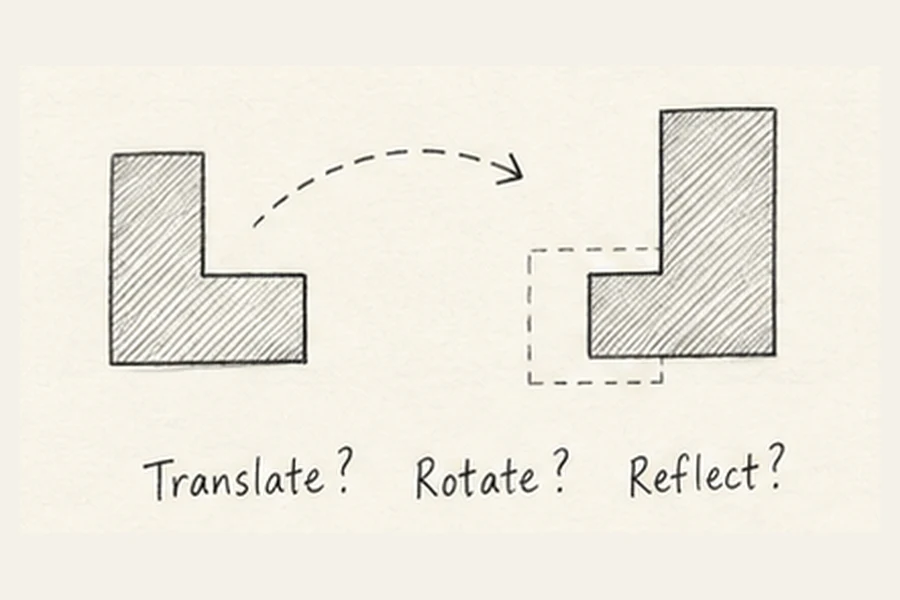
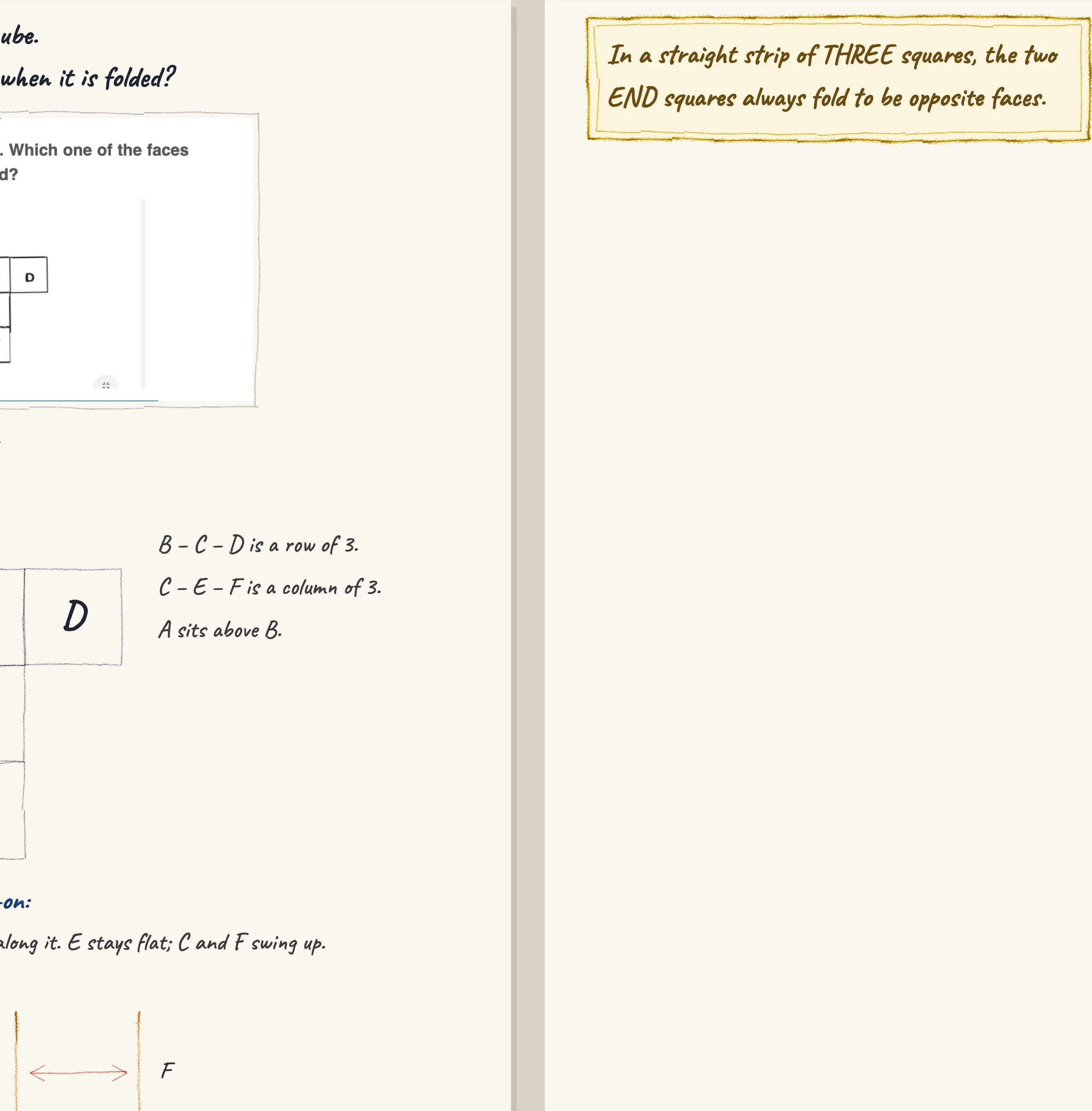
A shape gets folded, cut or rearranged, and the answer comes from tracking where each piece lands rather than from a formula. A fold reflects one part onto another, so an angle either side of the crease survives unchanged. A strip of three squares folded into a cube always sends the two ends to opposite faces.
How to spot it
Words like 'folded', 'cut along the dotted line' or 'stacked' appear beside a shape, and the question asks for a length or angle that only makes sense once the pieces are in their new positions.
Common mistake
Children try to calculate the answer before working out where the pieces actually end up, skipping the visualisation step that the whole question depends on.
47 worked solutions
Standard
- combine plane shapes Two equal squares are joined as shown. What larger plane shape do they make?
- combine plane shapes Two triangles are joined as shown. What larger plane shape do they make?
- complete a shape pattern The shown pattern repeats small, large. What belongs in the blank?
- complete a shape pattern The shown pattern repeats circle, square. What belongs in the blank?
- complete a symmetric figure Complete the shown half-figure by reflecting it across the dashed line.
- complete a symmetric figure Complete the shown half-figure by reflecting it across the dashed line.
- copy a figure on a grid Copy the shown stepped four-segment figure on a square dot grid.
- copy a figure on a grid Copy the shown corner-shaped three-segment figure on a square dot grid.
- draw a plane representation of a solid Draw a plane representation of a cuboid.
- draw a plane representation of a solid Draw a plane representation of a cube.
- draw a rectangle Draw a rectangle 6 cm by 4 cm.
- draw a square Draw a square of side 5 cm.
- draw parallel lines Draw a line parallel to the shown upper horizontal line.
- draw parallel lines Draw a line parallel to the shown lower horizontal line.
- draw perpendicular lines Draw a line perpendicular to the shown vertical line.
- draw perpendicular lines Draw a line perpendicular to the shown horizontal line.
- identify a line of symmetry Is the dashed line a line of symmetry for the shown rectangle?
- identify a line of symmetry Is the dashed line a line of symmetry for the shown rectangle?
- identify a plane representation of a solid What plane shape represents the shaded front face of the shown cuboid?
- identify a plane representation of a solid What plane shape represents the shaded front face of the shown cuboid?
- identify a solid from its net Which solid is formed when the shown net is folded?
- identify a solid from its net Which solid is formed when the shown net is folded?
- identify shapes inside a figure How many triangles can you see inside the shown square with both diagonals?
- identify shapes inside a figure How many triangles can you see inside the shown square with one diagonal?
- Net of a cube — the opposite face The figure is the net of a cube. Which face is opposite face A when it is folded?
- recognise a plane shape Name the basic plane shape shown with 4 straight sides.
- recognise a plane shape Name the basic plane shape shown with 3 straight sides.
- recognise a solid shape Name the solid in the shown drawing with a longer rectangular front face.
- recognise a solid shape Name the solid in the shown drawing with equal-looking edges.
- recognise a symmetric figure Does the shown figure have a line of symmetry?
- recognise a symmetric figure Does the shown figure have a line of symmetry?
- recognise a valid net Can the shown arrangement of six squares fold to make a cube?
- recognise a valid net Can the shown arrangement of six squares fold to make a cube?
- recognise perpendicular and parallel lines Are the shown separated lines perpendicular or parallel?
- recognise perpendicular and parallel lines Are the shown intersecting lines perpendicular or parallel?
- rectangle properties State two properties shown by the rectangle.
- square properties State two properties shown by the square.
Challenging
- Canvas — cut into a square and eight triangles Ravi has a square piece of canvas of side 31 cm. He cuts along the dotted lines to get one small square of area 289 cm² and 8 iden…
- Devi's square — eight triangles Devi has a square of paper of side 23 cm. She cut along the dotted lines to get one small square of area 49 cm² and 8 identical ri…
- Folded flag — the scout leader's crease angle At a campsite, a scout leader folds a rectangular flag along a diagonal crease from its top-left corner to its bottom-right corner…
- Folded kite fabric — the kite-maker's crease angle In her workshop, a kite-maker folds a rectangular sheet of kite fabric along a diagonal crease from its top-left corner to its bot…
- Folded napkin — the angle at the crease During a busy dinner service, a waiter folds a rectangular paper napkin along a diagonal crease running from its top-left corner t…
- Folding angle — find x Gizelle has a rectangular piece of paper. She folded it along the dotted line (the diagonal, from the top-left corner to the botto…
- Kite paper — triangle LMN Farhan has a square kite paper of side 28 cm. He cuts along the dotted lines to get one small square of area 16 cm² and 8 identica…
- Mrs Lim's scarf — cut into eight triangles Mrs Lim has a square scarf of side 21 cm. She cuts along the dotted lines to get one small square of area 9 cm² and 8 identical ri…
- Painted block — Ravi cuts it into cubes Ravi had a rectangular block of wood 10 cm by 5 cm by 4 cm. He painted all the faces of the block. (a) What is the total painted a…
- Rectangle — a square bitten out of one corner A rectangle has a length of 18 cm and a width of 9 cm. A square of side 4 cm is cut from one corner. Find the area of the remainin…
The 33 problem patterns
All 33 patterns, one to a page — the 19 behind Primary 5 and 6 word problems, and the skills the younger years are built on. The bar model, how to spot it in the question, and the mistake children make. A booklet you can print. Free.