The pattern
Branching
The second fraction is of one piece, not of the whole.
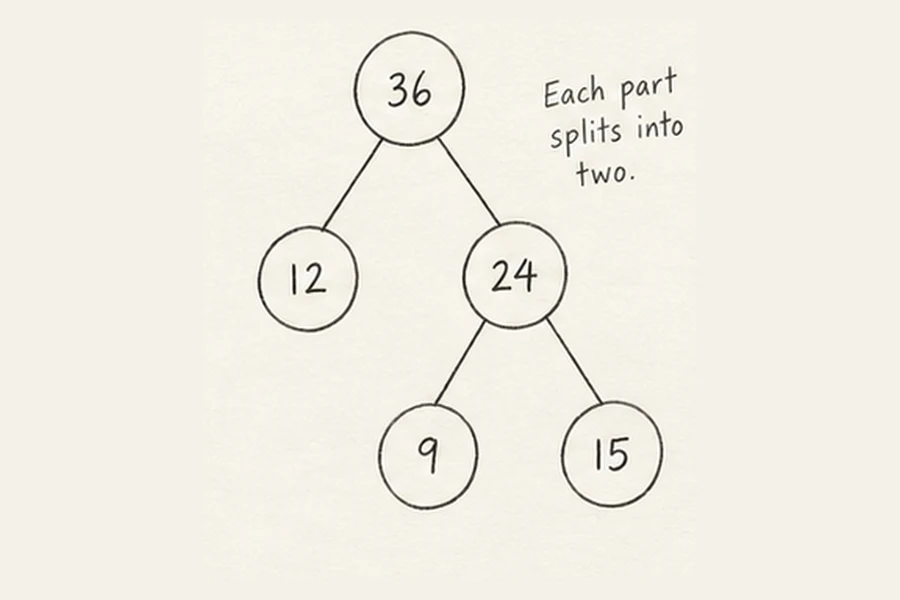
Something is cut in two, and one of the pieces is then cut again. The second fraction is never of the original pile: it is of the piece the question names — what was left after the first spend, or a part called out by name. Draw it as branches, and multiply along a branch to get that piece as a fraction of everything.
How to spot it
A second fraction arrives after the first and is attached to a piece rather than to the whole — 'of the remainder', 'of what was left', or 'of the ones that were red'.
Common mistake
Children take the second fraction of the original total instead of the piece it was named against, which makes the amount come out too big.
19 worked solutions
Standard
- A dress and a handbag — Mei's savings Mei spent $48 on a dress. This was 3/8 of her savings. After buying the dress, she spent 1/5 of the remaining savings on a handbag…
- Ahmad's savings — books, then a game Ahmad spent $36 on books. This was 4/9 of his savings. After buying the books, he spent 1/3 of the remaining savings on a game. Ho…
- Ali's stickers — shared with Ben and Carol Ali gave 1/6 of his stickers to Ben and 2/5 of the remainder to Carol. If Ali had 90 stickers at first, how many did Carol receive…
- Flour — Mrs Tan's cake and cookies Mrs Tan used 2/3 of her flour to bake a cake and 1/4 of the remainder for cookies. What fraction of the flour was left?
- Fractions Branching Reese made candles and pins. 3/8 of the items were candles. She sold 2/9 of the candles and 84 pins, and 5/12 of the items were le…
- Mr Lim’s salary — amount saved Mr Lim spent 3/8 of his salary on household and medical expenses, with 4/9 of the household expenses equal to 2/3 of the medical f…
- Mr Ong's pay — rent then groceries Mr Ong earns $1200 a month. He spent 1/2 of it on rent and 1/3 of the remainder on groceries. How much money did he have left?
- Mrs Tan's $72 — groceries then a gift Mrs Tan had $72. She spent 1/6 of it on groceries and 3/5 of the remainder on a birthday gift. How much did she spend on the gift?
- Paint — the walls and the door A painter had 20 litres of paint. He used 3/4 of it to paint the walls and 1/5 of the remainder to paint the door. How many litres…
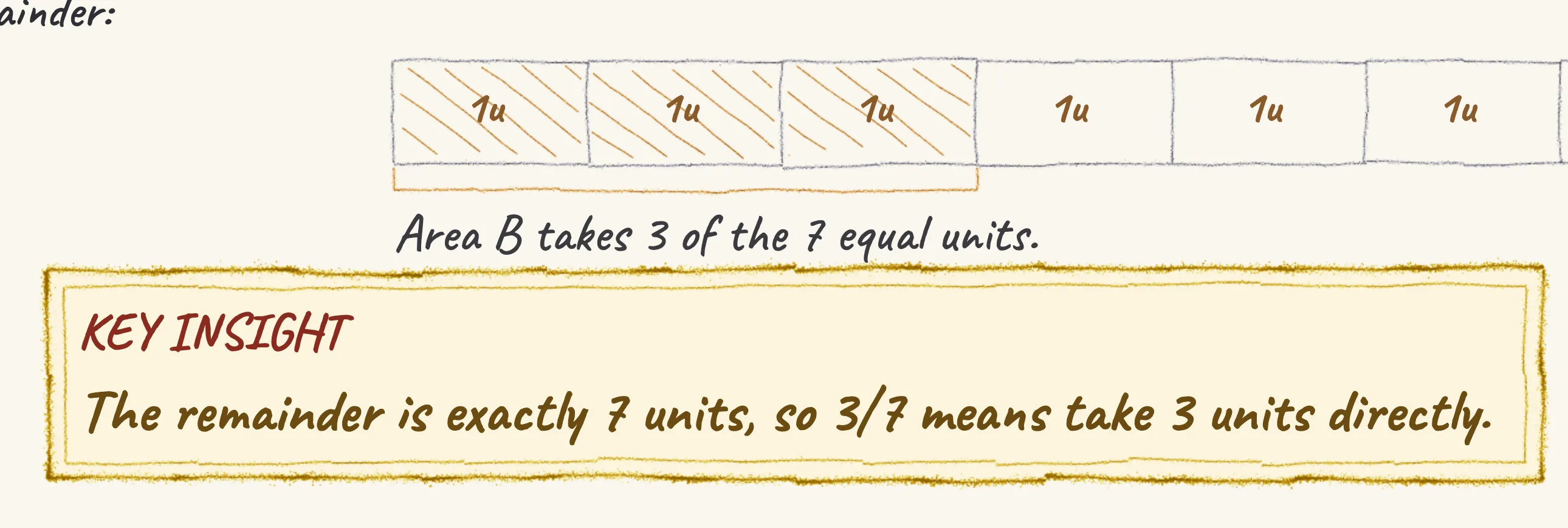
- Rope — fencing area A and area B A farmer had 96 m of rope. He used 1/8 of it to fence area A, and 3/7 of the remainder to fence area B. How many metres of rope di…
- Stickers — Priya gives some away, 36 left Priya had some stickers. She gave 3/8 of her stickers to her sister. Then she gave 2/5 of the remaining stickers to her friend. Sh…
Challenging
- John's money — T-shirt, shoes, and $120 from his parents At first, John had some money. He spent 1/4 of it on a T-shirt and 2/5 of the remainder on a pair of shoes. After that, his parent…
- Piggy bank — a video game, headphones, and an uncle's gift Ravi had some money saved in his piggy bank. He spent 1/4 of it on a video game and 2/5 of the remainder on a pair of headphones. …
- Priya's money — supplies, a tote, and her aunt's gift Priya had some money. She spent 1/4 of it on art supplies and 2/5 of the remainder on a canvas tote bag. After that, her aunt gave…
- Savings — a novel, a backpack, and grandmother's gift Mei had some savings. She spent 1/4 of it on a novel and 2/5 of the remainder on a backpack. After that, her grandmother gave her …
Very challenging
- Brown and white eggs — a farmer sells some of each A farmer collected some eggs. 5/8 of them were brown eggs and the rest were white eggs. After selling 60 white eggs and 4/5 of the…
- Cookies — Mrs Hoon's chocolate and almond batch Mrs Hoon made some cookies to sell. 3/4 of them were chocolate cookies and the rest were almond cookies. After selling 210 almond …
- Mr Koh's stickers — animal and cartoon Mr Koh had a collection of stickers. 3/5 of them were animal stickers and the rest were cartoon stickers. After giving away 120 ca…
- Muffins — blueberry and raisin Mr Lim baked some muffins to sell. 2/3 of them were blueberry muffins and the rest were raisin muffins. After selling 90 raisin mu…
The 33 problem patterns
All 33 patterns, one to a page — the 19 behind Primary 5 and 6 word problems, and the skills the younger years are built on. The bar model, how to spot it in the question, and the mistake children make. A booklet you can print. Free.